Roth conversions in retirement
Josh Rendler, CFP®
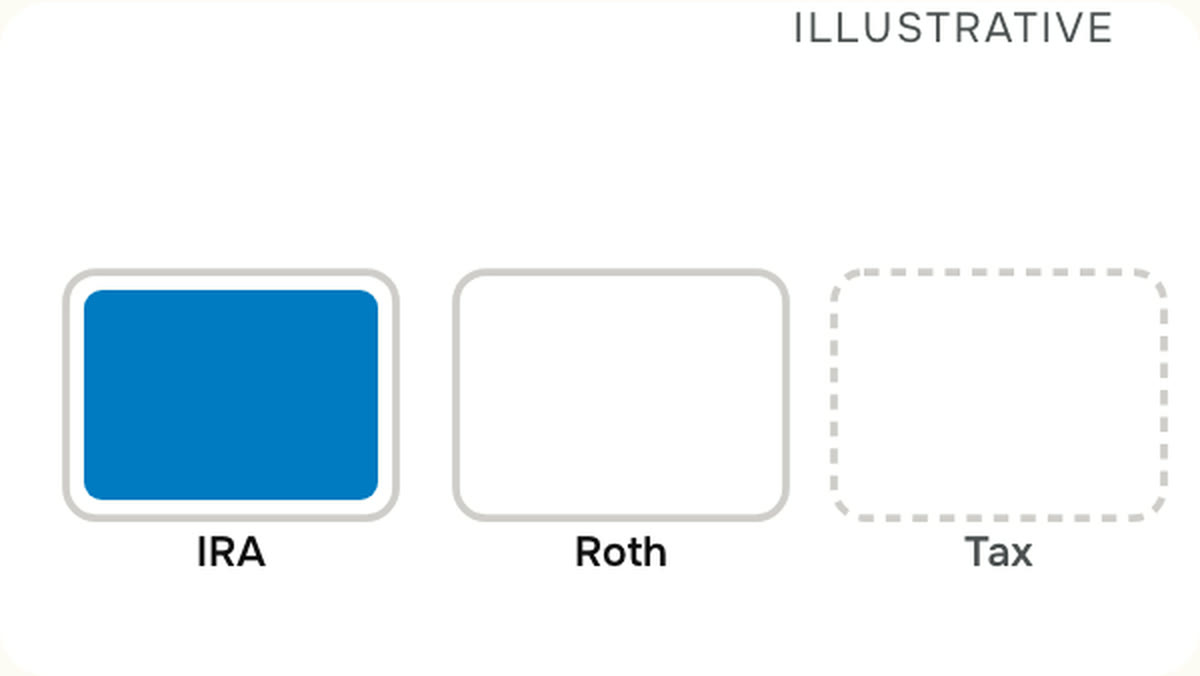
A Roth conversion moves money from a pre-tax retirement account into a Roth account and you pay the tax on it now. It tends to help when your tax rate today is lower than the rate you expect later, and it tends to hurt when it isn’t.
The short version
- A conversion moves money from a pre-tax account to a Roth, and you pay the tax on it in the year you move it.
- It helps when your rate today is lower than the rate you expect later. That is the whole test.
- The years after your paycheck stops and before required withdrawals begin are usually your lowest-rate years.
- Converting raises your income, and income drives your Medicare premium two years later and how much of your Social Security is taxed.
- If your rate is higher now than it will be later, or the money is going to charity anyway, converting usually costs you.
What is a Roth conversion?
A Roth conversion moves money out of a traditional IRA or 401(k) and into a Roth account. The amount you move counts as income that year, so you pay tax on it now instead of later. After that, it grows and comes out tax free.
That’s the whole mechanism. Everything else is timing.
It is not a contribution, so the annual contribution limits do not apply and there is no income limit on doing it. There is also no undo. Recharacterizing a conversion used to be possible and is not anymore, which is why the arithmetic belongs before the transaction rather than after it.
How is a Roth conversion taxed?
The converted amount is added to your ordinary income for that year and taxed at your ordinary rates. It is not a separate rate and it is not a capital gain. It simply stacks on top of whatever else you reported.
Pay the tax from outside the IRA if you can. Withholding the tax out of the conversion itself means less money lands in the Roth. Under 59½ it can also be treated as an early withdrawal of the part you kept.
The tax is due as the income arrives, not the following April. Estimated tax runs in installments through the year. A large conversion in November can carry an underpayment charge even if you pay the full amount on time in April. Two things soften that. There are safe harbors keyed to your prior year’s tax. And tax withheld — including tax withheld from a retirement account distribution taken in December — is treated as paid evenly across the year, not on the day it left. Which of those fits a particular conversion is a question for whoever prepares your return, and it is worth asking before the conversion rather than after it.
- Only the pre-tax portion is taxable. If you have after-tax money in a traditional IRA, a formula decides how much of any conversion is taxable, and it looks at all of your IRAs together rather than the one you converted from.
- It is taxed at your marginal rates, so the first dollars converted are cheaper than the last ones. That is true of the rate. It is not always true of the total cost of a dollar, because how much of your Social Security is counted stops climbing once it hits its ceiling, and the Medicare surcharge steps rather than ramps — how much of your Social Security is taxable shows the first of those.
- Each conversion starts its own five-year clock for penalty-free access to that converted amount.
- It raises your income, which is a separate matter from your tax bill. See the section below.
Why the years between retiring and RMDs matter so much
Most people have a stretch of years after their paycheck stops but before required withdrawals begin. Income drops. Then it climbs again at 73 if you were born from 1951 through 1958, or at 75 if you were born in 1960 or later, whether you want it to or not. Birth year 1959 is the one gap: the paragraph of the regulation that would set the required withdrawal age for it is marked reserved and left blank, so it is genuinely unresolved rather than something you have missed.
Those middle years are often the lowest-tax years you’ll ever have. They’re also the easiest ones to waste, because nothing forces you to do anything with them.
The window has a specific shape. It opens when your earned income stops, which is usually the year after you retire rather than the year you retire. It narrows when Social Security starts, because that adds taxable income back. It narrows again when required withdrawals begin. Converting is still allowed after that — the required amount has to come out first, and it takes up the room a conversion used to have. So for a lot of people the widest part is a handful of years in their sixties. Those years arrive without any announcement.
Nothing about this is urgent in the way the internet makes it sound. Missing a year is not a catastrophe. It is just one fewer year of a finite set, and the set does not refill.
- The window opens once earned income stops, which is often the calendar year after your last day.
- It narrows when Social Security begins, and again if a pension starts.
- It narrows again when required withdrawals begin, at 73 or at 75 depending on your birth year. Converting is still allowed after that — the required amount has to come out first, and it takes up the room a conversion used to have.
- A single large conversion late in the window usually costs more than the same total spread across it — but that holds only while spreading keeps each year under a line. If the balance is large enough that every year of the ladder clears the same threshold anyway, the spread does not avoid that threshold, it pays it once per year.
- A decline changes the price of the window, not just its width. Converting a set number of shares after a fall moves the same holding for less taxable income, and the recovery happens inside the Roth. The cost is that it uses bracket space in a year you may also want to realize losses in a taxable account, and it still needs cash outside the IRA to pay the tax — in a year when that cash has fallen too.
- A married couple should assume one of them will eventually file as a single person, on brackets that are narrower than the joint ones, with much of the same income still arriving. That is an argument for using the joint years while you have them — see what the survivor is left with.
The part people miss
A conversion raises your income for the year, and income drives more than your tax bill. Income is the thing everything else is bolted to. Nudge the dining table an inch and every chair around it has to move, whether you meant to move them or not. A conversion can change what you pay for Medicare two years later. It can change how much of your Social Security is taxed. So the question is never just what bracket am I in. It’s what else moves when your income moves.
This is the difference between a conversion that looked fine on a calculator and one that worked. A calculator asks what rate you pay on the converted amount. The real question is what the whole year costs once everything bolted to your income has moved with it.
- Your Medicare surcharge, two years later, if you are 65 or older by then.
- Your marketplace premium in the same year, if you are not yet 65.
- How much of your Social Security is taxed, which rises with your other income.
- Tax on your investment income, which has its own income thresholds.
- Any credit or deduction that phases out with income, all of which move at once.
If it helps to have the numbers in one place, I keep them all in the Ultimate Retirement Guide.
A worked example: filling the window on purpose
The reason conversions get talked about as a multi-year plan rather than a single decision is easiest to see with a balance and a calendar.
Illustrative example
Tom and Susan, both 64, retired last year, born in 1962
They have $1,000,000 in a traditional IRA and no paycheck. Because they were born in 1960 or later, their required withdrawals begin at 75, which gives them a stretch of low-income years first.
They decide to convert a set amount each year rather than a large amount once, so that no single year pushes their income somewhere expensive.
They also hold cash in a brokerage account, which is where the tax on each conversion comes from — see above.
- Traditional IRA balance today
- $1,000,000
- Years before required withdrawals begin
- 11
- Converted each year
- $50,000
- Tax paid from outside the IRA
- An amount that depends on their bracket, not shown here
- Total moved to the Roth over the window
- $550,000
- Left in the traditional IRA
- $450,000
This ignores growth on both sides, which would change every total and none of the shape. The point is the calendar, not the compounding.
Eleven smaller conversions do something a single large one cannot. Each year’s amount can be sized to stop before the next bracket, or before an IRMAA threshold. A single large one cannot.
That advantage depends on the sizing actually working. For a much larger balance than this one, a ladder long enough to empty the account can clear the same IRMAA tier in every year of it, and the surcharge is charged in every one of those years. Fewer, larger years cross that line fewer times. Which shape wins is arithmetic on the real balance and the real thresholds, not a rule.
It also shows the real cost of waiting. Start at 70 instead of 64 and the same plan has five years to work in rather than eleven. Each year has to carry more, at a higher rate.
Whether any of this is right for them depends on the rates they expect later. That is a question about their own numbers, not one this page can answer.
A hypothetical household with round numbers, built to show the arithmetic. Not a real person, and not a recommendation.
What is the five-year rule for Roth conversions?
Each amount you convert has to sit in the Roth for five years. Until then, taking that particular amount out carries a penalty if you are under 59½. Convert in three different years and you have three separate clocks running.
There is a second, different five-year rule that decides when the earnings in a Roth come out tax free. That one starts with your first Roth account and never restarts. People routinely mix the two together, which is how someone concludes they are stuck for five years when they are not.
The practical version is simple enough. If you are over 59½ and have held a Roth IRA for at least five years, neither clock affects you. Not probably — definitely. The conversion clock only carries a penalty below 59½, and the earnings clock has already run. If you are converting in your fifties and might need that money soon, both of them matter and the order you do things in matters.
- A Roth 401(k) runs its own five-year clock, and rolling one into a Roth IRA does not bring that clock with it. The receiving Roth IRA’s own clock is the one that counts afterwards — which helps you if you have held that Roth IRA for years, and hurts you if you opened it to receive the rollover. This is worth checking before you move anything.
What people get wrong about Roth conversions
Almost every mistake here comes from treating a conversion as a single tax question. It is really an income question, with tax as one of its consequences.
- "Roth is always better." It is better when your rate later is higher than your rate now. That is a question, not a slogan.
- Looking only at the bracket. The same conversion can move your Medicare premium two years later and change how much of your Social Security is taxed.
- Converting the whole balance in one year. That is usually the most expensive way to do it, because the last dollars are taxed at the highest rate.
- Paying the tax out of the conversion. Less arrives in the Roth, and the part withheld may be treated as a withdrawal.
- Forgetting the five-year clock on each converted amount before taking that money back out.
- Converting money that was headed to charity anyway. Giving directly from the IRA avoids the tax entirely, so converting first pays a tax nobody had to pay.
- Waiting for a better year that never arrives. The window between retiring and required withdrawals is finite, and it narrows on a schedule.
When this does NOT apply to you
If your rate today is higher than the rate you expect in the future, paying tax early is simply paying more. That’s common for people still working, and for people who plan to leave money to charity, where the tax gets avoided anyway. There’s no universal answer here, only your own set of numbers.
A conversion is the wrong tool more often than the internet suggests. These are the cases where I would want a very good reason before doing one at all.
- If you are still working and in your peak earning years. Adding income on top of a salary is usually the most expensive time to do it.
- If the money is going to charity. A charity receives a traditional IRA without the tax, so converting first buys nothing.
- If you would have to pay the tax from the IRA itself and there is no cash outside it.
- If you need the money within 5 years, because the clock on each converted amount has not run.
- If your heirs are in a lower bracket than you are. The tax follows the account, and it is not always your rate that matters.
- If the conversion pushes you over an IRMAA threshold for a small benefit. The surcharge is a cliff and the benefit is a slope.
How this connects to the other six
A conversion is not really a Roth decision. It is an income decision, and income is what every other topic on this site is priced off.
- Healthcare in retirement is where a conversion shows up again. Before 65 it can raise your marketplace premium in the same year, and after 65 it sets your Medicare surcharge two years later.
- Required minimum distributions (RMDs) and qualified charitable distributions (QCDs) are the deadline that makes the window finite, and converting is the main way to make that future withdrawal smaller.
- Withdrawal strategy is the same decision viewed annually, because converting and withdrawing both fill the same brackets.
- Social Security timing interacts directly, since delaying benefits is often what keeps the low-income window low enough to convert into.
- Estate and legacy is where the answer sometimes flips, because whether a conversion helps can depend on the bracket of whoever inherits.
Sources (7)
- Treas. Reg. §1.401(a)(9)-2(b)(2)(iv) — "In the case of an employee born on or after January 1, 1951, but before January 1, 1959, the applicable age is age 73" (opens in a new tab) · checked 2026-08-01
- Treas. Reg. §1.401(a)(9)-2(b)(2)(vi) — "In the case of an employee born on or after January 1, 1960, the applicable age is age 75" (opens in a new tab) · checked 2026-08-01
- Treas. Reg. §1.401(a)(9)-2(b)(2)(iv)–(vi) — the required withdrawal age is 73 for someone born from 1951 through 1958, and 75 for someone born in 1960 or later. The paragraph that would set it for birth year 1959, (v), is printed in the regulation as reserved and left blank, so that year is genuinely unresolved. (opens in a new tab) · checked 2026-08-01
- SSA POMS HI 01101.020 — MAGI is taken from the tax return two years prior, or three years prior when the two-years-prior return is unavailable (opens in a new tab) · checked 2026-07-31
- 42 U.S.C. §426(a) — "Every individual who— (1) has attained age 65" is entitled to hospital insurance benefits on meeting the remaining conditions of that subsection. (opens in a new tab) · checked 2026-08-06
- 26 U.S.C. §72(t)(2)(A)(i) — the 10-percent additional tax does not apply to distributions "made on or after the date on which the employee attains age 59½" (opens in a new tab) · checked 2026-08-06
- IRS Publication 590-B, Distributions from Individual Retirement Arrangements (IRAs) — the 5-year period for the additional tax on early distributions of converted amounts is "separately determined for each conversion and rollover" (opens in a new tab) · checked 2026-08-03