What Is the Mega Backdoor Roth? How It Works and Who It Fits
The mega backdoor Roth routes after-tax contributions in a workplace plan into a Roth account. The mechanism, the plan features it needs, and who it fits.
The mega backdoor Roth is a way of putting after-tax money into your workplace retirement plan and then moving it into a Roth account, where it grows and comes out tax-free.
That is the mechanism in full. Availability is the harder question, and most people who read about this strategy cannot use it, because their plan does not offer what it needs.
I want to be honest about that up front, because the usual version of this article is written as though the only obstacle is knowing the trick exists. It is not. The obstacle is your plan document.
What does “mega backdoor Roth” actually mean?
It means three separate money types, and the confusion starts because a workplace plan can hold all three.
Pre-tax deferrals are the ordinary contributions most people make. The money skips income tax going in and is taxed coming out.
Designated Roth contributions are the Roth 401(k). The statute defines one as an elective deferral that would otherwise be excludable from income, which the employee designates as not being so excludable (26 U.S.C. §402A(c)(1)). Read that carefully. A designated Roth contribution is a kind of elective deferral. It lives inside the same annual deferral limit as your pre-tax contributions, and choosing Roth does not give you more room. It gives you a different tax treatment for the same room.
After-tax contributions are the third type, and they are the entire subject of this article. They are not elective deferrals. They are not designated Roth contributions. They are ordinary employee contributions made with money that has already been taxed, and they sit in their own bucket in the plan.
That third bucket is where the strategy comes from. Because after-tax contributions are not elective deferrals, they are not counted against the elective deferral limit. They are counted against the plan’s overall annual additions limit instead — the ceiling on everything that lands in your account for the year. The statute defines an annual addition as the sum of employer contributions, employee contributions, and forfeitures (26 U.S.C. §415(c)(2)).
So the space that makes this work is the gap between those two ceilings. Your deferrals and your employer’s match fill part of the overall limit. Whatever room is left can potentially be filled with after-tax money.
Both of those limits are inflation-adjusted and change annually, which is why they are not written on this page. Look them up for the year you are actually in, not the year an article was written.
Then comes the second half. That after-tax money is moved into a Roth account, and from then on it behaves like Roth money. The name is a nod to the ordinary backdoor Roth, but the two are different mechanisms in different places, which is worth separating cleanly.
How is this different from a regular backdoor Roth?
A regular backdoor Roth happens in an IRA. You make a nondeductible contribution to a traditional IRA, then convert it to a Roth IRA. It exists because Roth IRA contributions phase out above an income threshold and conversions do not.
The mega backdoor Roth happens inside your employer’s plan. Different account, different rules, different scale. The plan version is called “mega” because the annual additions ceiling is a much larger number than the IRA contribution limit.
The most useful difference is the one nobody explains. The pro-rata problem is not the same problem in the two places.
In an IRA, the aggregation rule at 26 U.S.C. §408(d)(2) treats all your traditional IRAs as one account for purposes of figuring how much of a distribution is a return of basis. Section 408A(d)(4) applies that rule separately to Roth IRAs and to other individual retirement plans. The practical consequence is the one that trips up the ordinary backdoor Roth: if you hold a large pre-tax traditional IRA somewhere, a nondeductible contribution you convert is not treated as coming out clean. A share of the conversion is taxable, in proportion to the pre-tax money sitting in every traditional IRA you own.
Two details inside that rule decide how much of the conversion is taxable, and both are routinely missed.
The balance is measured at year end, not on the day you convert. The same subsection says the value of the contract “shall be computed as of the close of the calendar year in which the taxable year begins,” increased by any distributions taken during that year (26 U.S.C. §408(d)(2)(C)). So emptying a traditional IRA in February and converting in March does not help if the money is back in an IRA by December 31. The measurement date is the last day of the year, and everything before it is provisional.
A balance that is not in an IRA is not in the aggregate. The rule reaches “individual retirement plans.” An employer plan is not one, so pre-tax IRA money rolled into a 401(k) that accepts incoming rollovers — before the year ends — is outside the calculation. This is the one real fix for a large pre-tax IRA standing in the way of a backdoor conversion, and whether it is available at all depends on your plan document.
The computation itself, and the record of your IRA basis, live on Form 8606. That form is not optional and it is not a formality: basis you never reported is basis you cannot prove, and unproved basis gets taxed a second time on the way out.
That rule is an IRA rule. It does not reach your 401(k). A large pre-tax balance in your workplace plan does not contaminate an after-tax conversion inside that same plan, because the plan accounts for after-tax contributions separately.
Which is genuinely good news, and it is also why so many articles about this strategy are muddled. They import the IRA pro-rata warning into a plan context where it does not belong, and then miss the pro-rata problem that does exist in the plan. That one is about earnings.
Why are the earnings taxable when you convert?
Because your after-tax contribution is basis and its growth is not.
The dollars you contributed were already taxed, so moving them to Roth costs nothing. Any investment growth on those dollars has never been taxed. When you move the whole thing into the Roth side, the in-plan Roth rollover rule includes in gross income any amount that would have been includible were it not part of a qualified rollover contribution (26 U.S.C. §402A(c)(4)). The growth is that amount.
I use a glass of water for this, and it is the right image. Your after-tax contribution is pure water. Every month it sits in the plan un-converted, a little juice gets poured in — the earnings. You cannot separate them later. When you drink, you drink the mix.
The consequence is entirely about timing, not about strategy. After-tax money contributed in January and converted in December has eleven months of growth attached to it, and that growth is taxable income in the year of the conversion. The same money converted the week it lands carries almost nothing.
This is why the plans that handle this best offer an automatic conversion — a feature that sweeps each after-tax contribution into the Roth account as it is made. If your plan has it, turn it on. If it does not, the conversion is a manual step you have to actually take, on a schedule, and forgetting is the most common way this strategy costs money instead of saving it.
None of that makes a taxable conversion wrong. It makes it a decision you should have made on purpose. A small tax bill on real growth is not a failure. Being surprised by it in February is.
What has to be true about your plan?
This is the gate, and it is the part most articles skip.
Your plan has to allow after-tax contributions. No employer is required to offer them. They are an optional plan feature, and many plans have simply never added one.
There is a real reason for that reluctance, and it is a nondiscrimination test. Under Treas. Reg. §1.401(m)-1(b)(1), matching contributions and employee contributions satisfy the rules for a plan year only if the plan passes the actual contribution percentage test of section 401(m)(2). The test compares how much highly compensated employees contribute against how much everyone else does — the regulation describes the rate for non-highly compensated employees as the benchmark used for testing the rate for highly compensated employees (Treas. Reg. §1.401(m)-1(b)(3)).
After-tax contributions are exactly the kind of contribution that only well-paid employees can afford to make in volume. So a plan that opens the door can fail the test, and correction under Treas. Reg. §1.401(m)-2(b) can mean distributing the excess back out to the people who contributed it. Getting money returned in March that you meant to have in a Roth account is not a disaster, but it is a real outcome, and it is why some employers decline to offer the feature at all.
Your plan also has to give you a way out of the after-tax bucket. There are two acceptable forms. An in-plan Roth rollover moves the money into the designated Roth account inside the same plan (26 U.S.C. §402A(c)(4)). An in-service distribution moves it out to a Roth IRA while you are still employed.
Here is the structural point worth knowing. The rule that locks your ordinary contributions in until you leave applies to amounts attributable to employer contributions made pursuant to the employee’s election — that is, to elective deferrals under a cash-or-deferred arrangement (26 U.S.C. §401(k)(2)(B)). After-tax employee contributions are not elective deferrals, so that particular restriction is not what stands in the way. What stands in the way is whether your plan document permits the withdrawal. It is a plan design choice, not a statutory prohibition.
Both features have to be present. Either one alone is useless. After-tax contributions with no route to Roth leave you with a bucket of already-taxed money that grows into taxable earnings. For most people that is worse than a plain taxable brokerage account, which at least offers capital gains treatment and a step-up at death.
So the first move is not a spreadsheet. It is a phone call. Ask your plan administrator three things, in plain language. Does the plan accept after-tax contributions beyond the regular deferral limit? Can I convert them in-plan, or take an in-service distribution of them? And is there an automatic conversion feature I can turn on?
Write down what they say. The answers live in the plan document, and a well-meaning wrong answer from someone on a phone line is common enough to be worth verifying in writing.
If it helps to have the numbers in one place, I keep them all in the Ultimate Retirement Guide.
When the money finally comes out, is it tax-free?
Not automatically. Roth money in a plan comes out tax-free when the distribution is qualified, and “qualified” has a clock on it.
A distribution is not qualified if it is made within the five-taxable-year period beginning with the earlier of the first year you made a designated Roth contribution to the plan, or the year of a rollover from a prior Roth account (26 U.S.C. §402A(d)(2)(B)). There is also an age condition. Distributions taken before age 59½ generally carry an additional tax on the includible portion (26 U.S.C. §72(t)(1); IRS, Topic no. 557), though that additional tax reaches only what is includible, and your basis is not.
There is one more feature worth knowing about, and it is a recent and genuinely useful one. Designated Roth accounts in an employer plan are no longer subject to lifetime required minimum distributions. The statute now says plainly that section 401(a)(9)(A) does not apply to a designated Roth account (26 U.S.C. §402A(d)(5)). That aligns plan Roth money with Roth IRA money, and it removes a step that used to force people to roll a Roth 401(k) out to an IRA purely to avoid a distribution requirement.
What happens when you leave the employer?
Leaving usually makes this easier, not harder, because a separated participant has distribution options a current employee may not.
If the after-tax money is still sitting un-converted in the plan when you go, the rollover rules give it a clean home. Under 26 U.S.C. §402(c)(2), the portion of a distribution not includible in gross income can be rolled over if it goes in a direct trustee-to-trustee transfer to a qualified trust or a section 403(b) annuity contract that separately accounts for it, or to an eligible retirement plan described in the relevant clause — an IRA among them.
The mechanics of splitting a distribution are set out in IRS Notice 2014-54, which treats all disbursements to a recipient scheduled to be made at the same time as a single distribution, regardless of how many destinations the recipient directs them to. Pre-tax amounts are assigned first to any direct rollover. The practical effect is that a departing participant can send the after-tax basis to a Roth IRA and the pre-tax earnings to a traditional IRA, in one coordinated instruction, with no tax on the Roth side.
If you have already converted along the way, none of this comes up. The money is Roth, and it rolls to a Roth IRA like any other Roth balance. This is one more argument for converting promptly rather than letting after-tax dollars accumulate for years.
Who is this genuinely for?
A narrow group, and being honest about the boundaries is more useful than selling the idea.
It fits someone who is already maxing out their elective deferrals, already funding everything else worth funding, still has meaningful savings capacity left over, and happens to work somewhere with both plan features. That last condition is not a formality. It is the one that eliminates most people.
It fits best when there is a lot of runway. The value here is decades of untaxed growth, and the longer the money compounds, the more the strategy is worth. Someone in their forties with a high income and a cooperative plan is the case where the arithmetic is overwhelming. Someone a couple of years from retiring is a much closer call, and often the answer is simply that other planning matters more.
It also fits a household that expects a serious tax problem later. Large pre-tax balances do not stay quiet. They eventually produce required distributions, which raise income, which reaches the Medicare income-related monthly adjustment amount and the taxation of Social Security. Building a Roth balance alongside the pre-tax one is a hedge against that concentration.
Who should do something else first?
Ordering matters more than optimization, and this belongs late in the order.
Take the full employer match first. An unclaimed match is compensation you have declined. Nothing in this strategy competes with that.
Fund a health savings account if you are eligible for one. It has a tax treatment nothing else matches, and it is smaller and easier to fill.
Max out the ordinary elective deferral before reaching for after-tax. Pre-tax or designated Roth, the deferral limit is the room you should use first, and choosing between pre-tax and Roth there is a separate question with a real answer for your situation.
Deal with expensive debt and a cash reserve. Money in a plan is hard to reach. A strategy that leaves you illiquid is not a good strategy no matter how elegant the tax outcome.
If your plan lacks either feature, stop looking for a workaround. There isn’t one. A taxable brokerage account, held for the long run and managed for tax efficiency, is a perfectly respectable answer, and it keeps the money reachable.
And one more that gets skipped. If your marginal tax rate right now is unusually high and you expect it to be materially lower in a few years, filling Roth space at today’s rate may be the wrong sequencing even when the mechanism is available. Roth is not automatically better. It is better when the rate you avoid later exceeds the rate you pay now.
What do people get wrong about this?
Confusing after-tax with Roth. They are different contribution types. After-tax money left un-converted is not Roth money and does not get Roth treatment on its earnings.
Assuming the IRA pro-rata rule applies. The aggregation rule at §408(d)(2) is an IRA rule. It does not reach a workplace plan account.
Assuming their plan allows it. Most do not offer both required features. This is a document question, and it is answerable in one phone call.
Contributing and forgetting to convert. Every month of delay converts a little more of a tax-free contribution into taxable growth. The automatic conversion feature exists precisely because human beings forget.
Doing this before taking the match. The order is match, then the rest, then this.
Treating it as a substitute for planning. It is one funding technique. It does not decide your withdrawal sequence, your Social Security timing, or how you manage income against Medicare thresholds.
For the surrounding decisions — when converting pre-tax money makes sense, how conversions interact with Medicare premiums, and where Roth balances fit in a withdrawal plan — start at Roth Conversions. For the wider picture of getting the years before retirement in order, see the Getting Ready to Retire videos.
Illustrative example
Malcolm and Sylvia, both 61, and where the last dollars of savings go
Malcolm called his plan administrator and got both answers in writing: the plan accepts after-tax contributions, and it will sweep each one into the designated Roth account as it lands. Every figure below is round and invented, chosen to show the order rather than to describe anyone.
The match, a health savings account and the full elective deferral are already filled for the year. Their limits are looked up for the year they are actually in, so no figure for them appears here. This example starts with what is left after all three.
- Savings capacity left once the match, the health savings account and the full deferral are filled
- $24,000
- Held back in cash instead, to keep some of it reachable
- $6,000
- Available for after-tax contributions
- $18,000
- After-tax room the plan reports for the year
- $31,000
- Contributed after-tax, swept to Roth as each contribution lands
- $18,000
- Plan room left unused
- $13,000
The ceiling was never the binding constraint. Their capacity was. The plan reported more room than they had money to fill, which is the ordinary case and the opposite of how this strategy is usually described.
The sweep is what makes the arithmetic this plain. Because each contribution moves to the Roth side as it arrives, almost no growth accumulates in the after-tax bucket first, and there is no taxable earnings figure to carry. Without that feature the same plan requires a manual step on a schedule, and forgetting it is what turns a tax-free contribution into taxable income.
The cash they held back is not a failure of optimization. Money inside a plan is hard to reach, and a plan that leaves a household illiquid is not improved by being tax-efficient.
Whether after-tax dollars belong ahead of a taxable brokerage account for them depends on the rate they pay now against the rate they expect later, and on how long the money would compound. That is a question about their own numbers, not one this page can answer.
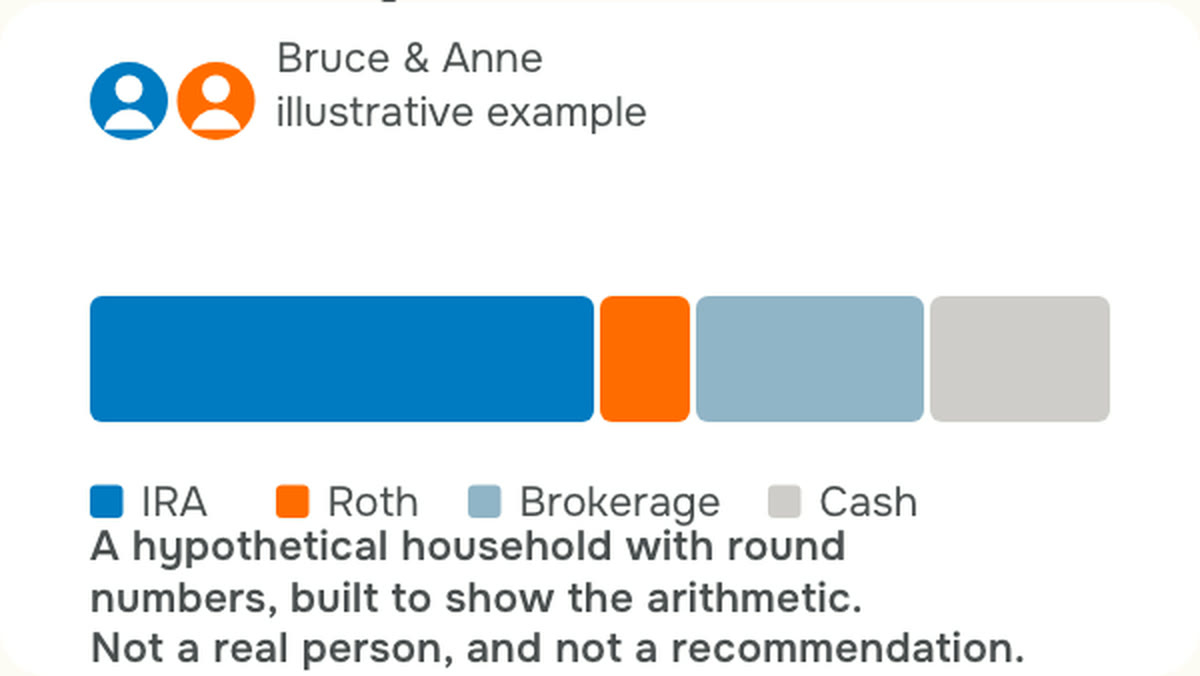
A hypothetical household with round numbers, built to show the arithmetic. Not a real person, and not a recommendation.
Sources (1)
Example case study. Details are changed and some examples combine more than one household. Nothing here is a recommendation, and your own numbers will be different.
