When to claim Social Security
Josh Rendler, CFP®
You can claim Social Security between 62 and 70, and waiting increases the monthly amount. The right age depends on more than life expectancy. It also shifts your taxable income, which affects your brackets and your Medicare premiums.
The short version
- You can claim from 62 onward, and waiting past your full retirement age keeps raising your own retirement benefit until 70. A spousal or survivor benefit does not work that way — neither one grows past full retirement age.
- Full retirement age is not one number. It runs from 66 to 67 depending on your birth date, and it is 67 if you were born on or after January 2, 1960.
- The break-even calculation is real and useful, and it is only part of the decision.
- How much of your benefit is taxed depends on your other income, so claiming age is a tax decision too.
- For a married couple the higher earner’s choice matters most, because that benefit is the one that continues after the first death.
- If you were married for at least 10 years and have not remarried, you may be able to claim on an ex-spouse’s record.
When can you claim Social Security?
You can start at 62. Waiting past your full retirement age keeps increasing your own retirement benefit, and that increase stops at 70. Claiming later than 70 is allowed and buys you nothing.
That is true of your own benefit only, and the exception is not a small one. A benefit paid on someone else’s record — as a spouse, or as a survivor — stops growing at full retirement age, and for a survivor that is a different age from the one defined just below. Waiting past it adds nothing at all. A widow or widower can also start much earlier than 62. Both of those are covered under what happens after the first death.
Full retirement age is not a single number, and this trips people up constantly. It runs from 66 to 67 depending on when you were born. If you were born on or after January 2, 1960, it is 67. Birth dates in between land on a ramp between the two. The boundary is a date rather than a year, so being born in 1960 is not by itself enough — it has to be on or after January 2.
So the real range of the decision is 62 to 70. Everything in between is available, month by month. It is a dial rather than three buttons.
The break-even math is the easy part
Claim earlier and you get smaller checks for longer. Claim later and you get larger checks for less time. There’s an age where the totals cross.
Everyone runs this calculation. It’s genuinely useful, and it isn’t the whole decision.
The break-even answer treats your benefit as the only thing moving. It isn’t. Your tax bill moves, your Medicare premium moves, and for a married couple the survivor’s income moves. Those are the three sections below.
How does claiming age change your taxes?
Social Security income is taxed differently from IRA withdrawals, and how much of it is taxed depends on your other income. It’s the last bag you try to fit in the trunk. Whether it goes in easily has almost nothing to do with the bag and almost everything to do with what you already packed.
Delaying can also protect your low-tax years. If you aren’t taking benefits yet, your income may be low enough to do other planning that stops being possible later.
That is the part the break-even calculation cannot see. Turning the benefit on fills bracket space you were going to use for something else. The years before you claim are often the cheapest years you will ever have to convert money to a Roth.
- More other income means more of your benefit is taxable, so the benefit and the withdrawal interact rather than simply adding up.
- Claiming raises your income, which sets your Medicare surcharge two years later once you are 65 or older.
- Not claiming leaves room in the low brackets, which is what makes a conversion cheap.
- A larger check later is a larger taxable amount later, so delaying moves the tax rather than only the income.
The income test that decides how much of your benefit is taxed
It depends on a figure that is not your taxable income and not your adjusted gross income. The test uses provisional income, which is your income plus half of your benefit, and it adds back tax-exempt interest.
That last part surprises people. Municipal bond interest sits inside this measure even though it sits outside your taxable income. Moving money into munis to keep this number down does not work the way it looks like it should.
There are two thresholds for each filing status, not one. Below the first, none of the benefit is taxed. Between the two, up to half of it can be. Above the second, up to 85 percent of it can be. The arithmetic, worked line by line, is in how much of your Social Security is taxable.
- On a joint return, the first threshold is $32,000 of provisional income and the second is $44,000.
- Filing single, they are $25,000 and $34,000.
- That 85 percent is a ceiling, not a rate. It is the most of your benefit that can be counted as income, not the amount of tax you pay on it. At least 15 percent of the benefit always stays out.
- These numbers are written into the statute itself, and nothing in it adjusts them for inflation. Every other figure on this site moves each year. These have not.
Can I claim Social Security on my ex-husband’s record?
Often yes, and a lot of people never find out. If your marriage lasted long enough and you have not remarried, you may be able to claim on an ex-spouse’s record.
The conditions are specific and they are not negotiable, so it is worth reading them slowly.
Whether any of this changes what your ex-spouse receives is the first thing almost everyone asks, and the belief that it does is the reason a lot of people never claim. It does not, in either direction. The regulation says a divorced spouse’s benefit is not reduced by the limit that applies to everyone else on a record, and that everyone else on that record is paid as if no divorced spouse were entitled at all. What you receive is not taken out of anyone else’s check.
- The marriage lasted at least 10 years, running right up to the divorce becoming final. Ten years spread across two separate marriages to the same person is a different question.
- You are not currently married. Remarrying generally ends this one. The rule reverses for a widow: remarrying after 60 does not end a survivor benefit on a late spouse’s record, and a marriage that lasted at least 10 years can also support a survivor benefit on a late EX-spouse’s record. Two different benefits, opposite rules on remarriage.
- You are 62 or older — and so is your ex. Your own age is not the only one that matters: if your ex has not claimed yet, they must have reached 62 as well.
- If your ex has not claimed yet, you also need to have been divorced at least 2 years.
- You do not get both. What is compared is your own benefit at full retirement age against the full spousal amount on their record, not the two reduced checks you might actually receive. If yours is the larger, you receive your own.
If it helps to have the numbers in one place, I keep them all in the Ultimate Retirement Guide.
What happens to a couple’s income after the first death?
The household goes from two checks to one. That is the plainest way to say it, and it is the part of this decision people plan for least.
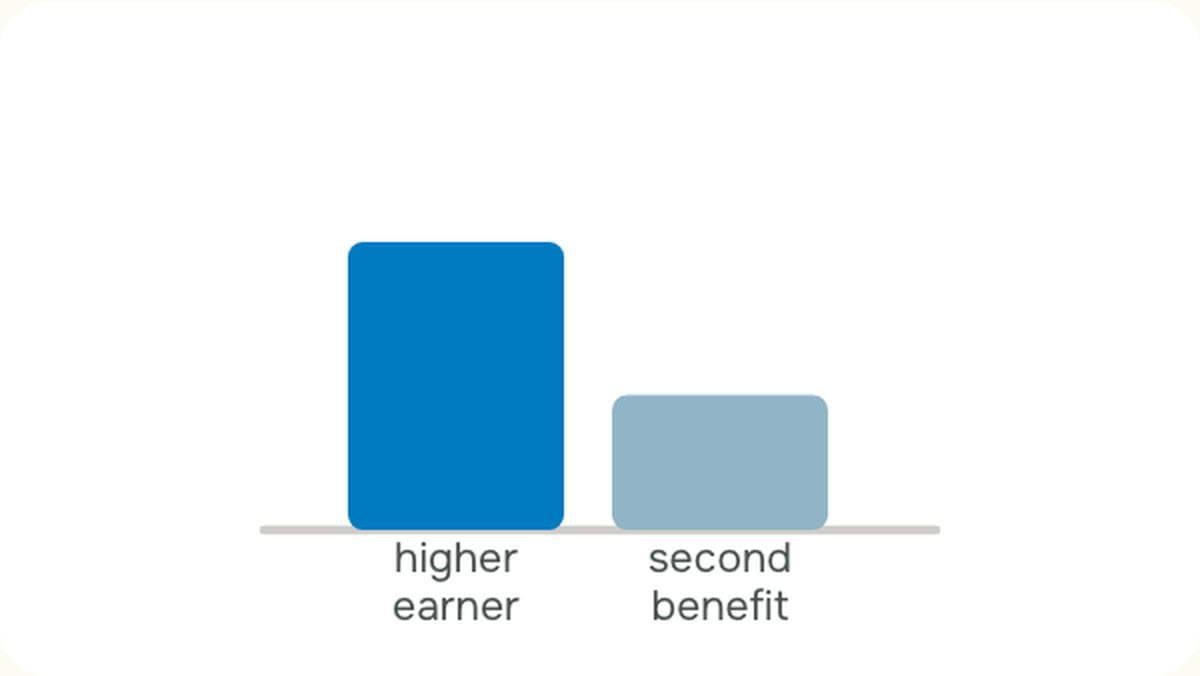
The higher earner’s choice tends to matter more, because that benefit is the one that continues after the first death.
That makes the higher earner’s claiming age partly a survivor-income decision. It is a different question from the break-even one, and it usually points in the other direction. Break-even asks how long you live. This asks how long the survivor does.
There is a tax side to it too. The survivor generally files as a single person afterwards, on brackets that are narrower than the joint ones. Less income, taxed on a tighter schedule.
The rules for a benefit paid on someone else’s record are genuinely different from the ones above, and the differences are the sort that change a decision rather than decorate it.
- A survivor can claim from 60, which is earlier than the 62 that applies to your own retirement benefit. Earlier still — from 50 — if they meet Social Security’s own definition of disability and the conditions that go with it, which include a time limit on when the disability began.
- Neither a spousal benefit nor a survivor benefit grows past full retirement age. The credits that keep raising a benefit for waiting apply to your own record and nothing else. Waiting past it to start either one adds nothing, which is the opposite of the advice people carry over from their own claiming decision. And a survivor’s full retirement age is not the one defined further up this page. It runs on its own table, and that table reaches 67 only for a birth date on or after January 2, 1962 — later than the one governing your own benefit. A widow reading her own statement’s number will overstate hers.
- A spousal benefit tops out at one-half of the higher earner’s primary insurance amount — the amount they would receive at their own full retirement age, not the amount they actually receive after claiming early or late. Starting a spousal benefit before your own full retirement age reduces it.
- The two can be taken in sequence. A widow or widower can start one benefit and switch to the other later, and which order is better depends on the two amounts and the two ages. This is the part worth working out on the real numbers, or asking Social Security directly, rather than assuming.
A worked example: what the survivor is left with
The clearest way to see why the higher earner’s decision carries more weight is to write down both checks, then take one away.
Illustrative example
Ray and Joan, a married couple deciding when Ray should claim
Ray is the higher earner. Joan has a benefit of her own. The figures below are round and invented, chosen only to show the shape of the arithmetic.
The question is not which of them lives longer. It is what the survivor is left holding, whoever that turns out to be.
When one spouse dies, the survivor keeps the larger of the two benefits. The smaller one stops. That is why Joan’s $1,400 does not appear in the last two rows — whichever of them is left, the household is living on Ray’s number.
- Ray’s monthly benefit if he waits
- $3,000
- Ray’s monthly benefit if he claims early
- $2,400
- Joan’s own monthly benefit
- $1,400
- Household each month, both alive, if Ray waits
- $4,400
- Household each month, both alive, if Ray claims early
- $3,800
- Continuing each month after the first death, if Ray waited
- $3,000
- Continuing each month after the first death, if Ray claimed early
- $2,400
- The monthly gap the survivor lives with
- $600
While both are alive, the two paths differ by $600 a month. That is a real difference and it is not a dramatic one.
After the first death, the same $600 is the entire gap between the two plans, for as long as the survivor lives. The decision stopped being about Ray a long time before that.
And because adjustments for inflation are applied as a percentage, that $600 gap grows in dollar terms every year the survivor lives.
This is why I treat the higher earner’s claiming age as a survivor question first. The break-even calculation asks how long Ray lives. This asks how long Joan does.
None of that makes waiting the right answer. If the years before 70 would mean draining the portfolio hard, claiming earlier can be the sounder plan. That is a question about their own numbers.
A hypothetical household with round numbers, built to show the arithmetic. Not a real person, and not a recommendation.
What people get wrong about Social Security timing
Most of these come from treating the benefit as a standalone decision. It is one income source among several, and the others move when it does.
- Thinking there are three choices. 62, full retirement age and 70 are landmarks, not the menu. Any month in the range is available.
- Assuming full retirement age is 67 for everyone. It runs from 66 to 67 by birth date, and only reaches 67 for people born on or after January 2, 1960.
- Running break-even and stopping there. It ignores tax, Medicare, and the survivor entirely.
- Forgetting the benefit is taxable at all. How much of it is taxed rises with your other income.
- Treating a couple as one decision. It is two, and they are not equally important.
- Not knowing about ex-spouse benefits. A marriage of at least 10 years may be worth a call to Social Security.
- "If I work, I lose part of my benefit." It is withheld, not forfeited. The benefit is recomputed at full retirement age to give the withheld months back.
- "Claiming early locks in a lower cost-of-living increase." The adjustment applies to your record from 62 whether you have claimed or not. What waiting changes is the amount it is applied to.
- "Waiting past full retirement age raises every benefit." It raises your own. A spousal or survivor benefit stops growing at full retirement age — and a survivor’s is a later age than the one on your own statement.
- Claiming to avoid touching the portfolio. Sometimes right. But it also fills the bracket space that made conversions cheap.
- "I’ll take the spousal benefit now and let my own grow." That door is shut for anyone born on or after January 2, 1954, which is everyone young enough to still be making this decision. If you are eligible for your own benefit and a spousal benefit in the same month, filing for one files for both, so there is nothing held back to switch to later. A survivor benefit is a different benefit and sits outside that rule, which is why the survivor section above says those two can be taken in sequence.
When this does NOT apply to you
The case for waiting gets repeated so often that it can sound like a rule. It isn’t one, and here is where it stops holding.
- If you need the income now. A plan you can live with beats an optimal one you can’t.
- If your health or family history points the other way. This is a personal input, not a spreadsheet input.
- If waiting means large IRA withdrawals to bridge the gap. You may simply be swapping a taxable withdrawal for a delayed benefit.
- If you are single with no survivor to plan for. The survivor argument is most of the case for delaying, and it does not apply to you.
- If you are the lower earner in a couple. Your claiming age matters much less, because your benefit is the one less likely to continue.
- If you are still working and under full retirement age. Part of your benefit can be withheld while you keep earning. It is not lost — your benefit is recalculated upward once you reach full retirement age, to give back the months that were withheld. It still changes the arithmetic, just not in the way the word "lose" suggests.
- If your spouse is waiting on a spousal benefit. A benefit on someone else’s record only exists once that person is entitled to their own, so while the higher earner delays, the household receives nothing on that side. For a couple whose lower earner has a small record of their own, that forgone amount is the real cost of waiting, and it belongs in the arithmetic alongside the larger check later. Note that this is not true of an ex-spouse, whose claim does not depend on the worker having filed.
How this connects to the other six
Claiming age is really a decision about what your income looks like for the rest of your life. Everything else on this site is priced off that.
- Roth conversions are cheapest in the years before you claim, because the bracket space is still empty.
- Healthcare in retirement responds directly, since turning the benefit on raises the income that sets your Medicare surcharge two years later.
- Required minimum distributions (RMDs) and qualified charitable distributions (QCDs) stack on top of the benefit, and the two together set your bracket in your seventies.
- Withdrawal strategy is what bridges the gap if you delay, so the two decisions are really one.
- Estate and legacy is shaped by it too, because the low-income years before claiming are when you can most cheaply change what your heirs inherit.
Sources (19)
- 20 CFR 404.310(a) — "You are at least 62 years old" (opens in a new tab) · checked 2026-07-31
- 20 CFR 404.313(a) — credits accrue "ending with the month you attain age 70" (opens in a new tab) · checked 2026-07-31
- 20 CFR 404.409(a) — for a birth date of "1/2/1960 and later", full retirement age is "67 years" (opens in a new tab) · checked 2026-08-02
- 20 CFR 404.409(a) — for a birth date of "1/2/1943—1/1/1955", full retirement age is "66 years" (opens in a new tab) · checked 2026-08-02
- 20 CFR 404.409(a) — the table's final row is birth date "1/2/1960 and later", full retirement age "67 years" (opens in a new tab) · checked 2026-08-02
- 20 CFR 404.331(a)(2) — "You were married to the insured for at least 10 years immediately before your divorce became final" (opens in a new tab) · checked 2026-08-02
- 20 CFR 404.331(f) — where the insured person is not yet entitled to benefits, "You have been divorced from the insured person for at least 2 years" (opens in a new tab) · checked 2026-08-02
- SSA POMS GN 00204.020.B.1.b — a claimant eligible for both RIB and spouse's (AUXSPO) benefits "must apply for both and cannot restrict their application to only one benefit" when they "are born January 2, 1954 or later and eligibility for both benefits exists in any month". The adjacent bullet covers those "born before January 2, 1954", for whom the rule bites only under full retirement age and only in the first month of entitlement. (opens in a new tab) · checked 2026-08-07
- 20 CFR 404.409(c) — "You may receive old-age, wife's or husband's benefits at age 62. You may receive widow's or widower's benefits at age 60." (opens in a new tab) · checked 2026-08-03
- 20 CFR 404.335(c) — "You are at least 60 years old; or you are at least 50 years old and have a disability as defined in § 404.1505 and you meet all of the conditions in paragraphs (c)(1) through (4) of this section" (opens in a new tab) · checked 2026-08-03
- 20 CFR 404.409(b), "What is my full retirement age for widow's or widower's benefits?" — for a birth date of "1/2/1962 and later", full retirement age is "67 years" (opens in a new tab) · checked 2026-08-03
- 20 CFR 404.409(b) — the widow's and widower's table's final row is birth date "1/2/1962 and later", full retirement age "67 years" (opens in a new tab) · checked 2026-08-03
- 42 U.S.C. §426(a) — "Every individual who— (1) has attained age 65" is entitled to hospital insurance benefits on meeting the remaining conditions of that subsection. (opens in a new tab) · checked 2026-08-06
- SSA POMS HI 01101.020 — MAGI is taken from the tax return two years prior, or three years prior when the two-years-prior return is unavailable (opens in a new tab) · checked 2026-07-31
- 26 U.S.C. §86(c)(1)(B) — the "base amount" is "$32,000 in the case of a joint return" (opens in a new tab) · checked 2026-08-02
- 26 U.S.C. §86(c)(2)(B) — the "adjusted base amount" is "$44,000 in the case of a joint return" (opens in a new tab) · checked 2026-08-02
- 26 U.S.C. §86(c)(1)(A) — the "base amount" is "except as otherwise provided in this paragraph, $25,000" (opens in a new tab) · checked 2026-08-02
- 26 U.S.C. §86(c)(2)(A) — the "adjusted base amount" is "except as otherwise provided in this paragraph, $34,000" (opens in a new tab) · checked 2026-08-02
- 26 U.S.C. §86(a)(2)(B) — the amount included in gross income is the lesser of the computed sum or "85 percent of the social security benefits received during the taxable year" (opens in a new tab) · checked 2026-08-02