Healthcare in retirement: before 65, at 65, and after
Josh Rendler, CFP®
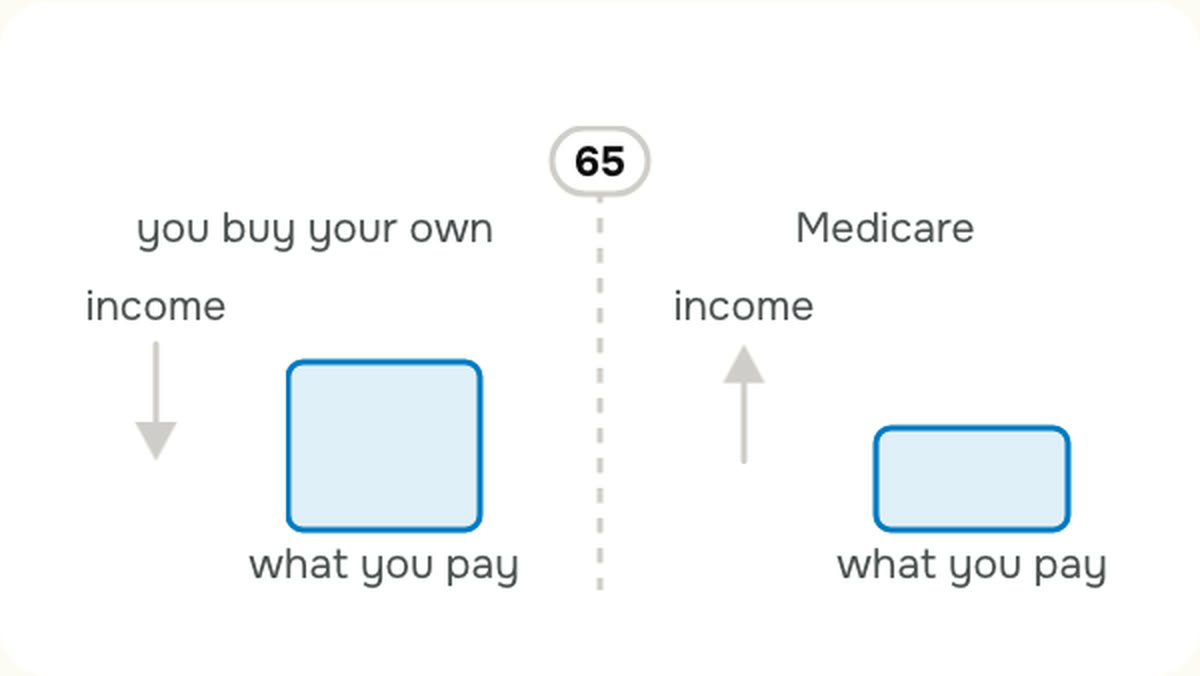
Healthcare in retirement is really two problems joined together. Before 65 you buy your own coverage, and what you pay depends heavily on the income you report. From 65 Medicare takes over. Above certain income thresholds you pay a surcharge called IRMAA, set by your tax return from two years earlier. Both ends are priced off your income, and that’s the part you can actually plan.
The short version
- Retire before 65 and you buy your own coverage until Medicare starts. For many people that one line item decides whether early retirement works.
- Before 65, marketplace subsidies are tied to the income you report, so lower reported income generally means a lower premium — up to a hard edge at 400 percent of the federal poverty line, above which the subsidy is not reduced, it is gone.
- From 65, Medicare takes over, and above certain income thresholds you pay a surcharge called IRMAA.
- IRMAA is set by your tax return from two years earlier, so the year you are living through now sets a premium you will pay later.
- IRMAA is a cliff rather than a ramp: a dollar over a threshold costs you the whole next tier, all year, per person.
- Both ends are priced off the same thing — your income in the year being measured — which is why this has to be planned early to matter at all.
If you retire before 65, the gap is the problem
Medicare starts at 65. If you stop working at 60, that’s five years to cover on your own.
For a lot of people this one line item is what decides whether early retirement is possible at all. It is also the one most often left until after the resignation letter, which is the wrong order. Every route below has its own window, and some of those windows close the day you stop working.
- The marketplace. Coverage anyone can buy, priced against your income. For most early retirees this is the main road, and it is covered in the next section.
- COBRA. Continuing your employer’s plan for a limited period. Same coverage you know, at the full unsubsidized cost, and there is a deadline to elect it. One warning belongs here rather than only further down the page: COBRA does not count as employer coverage for Medicare purposes. If you are near 65, it does not extend your Medicare enrollment window, and the Part B late-enrollment penalty it can trigger is permanent — see Medicare enrollment at 65 below.
- A spouse’s plan. Often the cheapest answer by a wide margin, if one of you is still working.
- Staying part time somewhere that offers coverage. Less common, and worth pricing before dismissing.
- None of them is automatically best. They just need comparing before you give notice, not after.
Before 65, your income matters more than you’d expect
Marketplace subsidies are tied to your income, and across most of the range they behave the way you’d expect. It’s priced the way shipping is priced. The box is the same box either way, and what you hand over at the counter comes down to the number on the scale. Lower reported income generally means a lower premium, and the relationship is strong enough to be worth planning around.
But the scale has an edge, and past the edge there is nothing. The premium tax credit is only available to a household whose income for the year comes in at or below 400 percent of the federal poverty line for a family of its size. A dollar above that line does not buy you a smaller credit. It buys you no credit at all — the whole subsidy, for the whole year, gone.
So this is a cliff, not a ramp, in exactly the way IRMAA is a cliff further down this page. Both ends of retirement healthcare are priced off your income, and both of them charge you in one step rather than by the inch. That is the single most useful thing to know about either.
The line moves, which is why it is worth checking rather than remembering. It is a percentage of the federal poverty line, and the poverty line is republished every January and depends on how many people are in the household — so the dollar amount is not the same for a couple as for a single person, and not the same this year as last. The percentage is the part that stays put.
If what you know about this came from the last few years, it is now out of date. The cap was suspended for a stretch of recent tax years, and during that stretch the credit really did taper away smoothly with no upper limit at all. The suspension has expired. The cliff is back, and it is back for the years an early retiree is living through right now.
This runs directly against Roth conversion strategy, and far harder than it used to. Converting raises your income, which can raise what you pay for coverage — and if the conversion carries you across the line, it costs you the entire credit rather than a slice of it. Two good ideas that fight each other, in the same years, with a trapdoor between them.
What is IRMAA?
IRMAA is a surcharge on your Medicare premiums that applies once your income is above certain thresholds. The letters stand for income-related monthly adjustment amount, which is a long way of saying higher earners pay more for the same coverage.
It is added to both Part B and Part D. It is not a tax, and it is not means testing in the way people usually mean that phrase. Everyone gets the same Medicare. Some people pay more for it.
The surcharge is per person, not per household. A married couple who are both on Medicare and both over a threshold pay it twice.
How is IRMAA calculated, and when does it kick in?
It is calculated from one number on one tax return: your modified adjusted gross income, from the return two years before the premium year. That is the whole input. Not your current income, not your savings, not your net worth.
So the year you are living through right now is the one that sets a premium you will pay later. A large one-off income year follows you. A big conversion, a property sale, or a bonus in your final working year all show up again, two years on.
It kicks in the month your Medicare coverage starts, if the return being looked at was above a threshold. Social Security sends a letter saying so.
That lookback also joins the two halves of this page together. The income you report to get a cheaper marketplace premium before 65 is the same income that sets your Medicare surcharge afterwards. They are not separate decisions, they are the same decision measured twice.
And it is a cliff, not a ramp. Most of the tax code phases in gradually. IRMAA doesn’t. It behaves like the clearance bar at the entrance to a parking garage. An inch under and you drive straight through without thinking about it. An inch over and the answer isn’t a little worse, it’s a completely different answer. Go one dollar over a threshold and you pay the whole next tier, all year, per person.
For a married couple that means paying it twice. That shape is what makes this worth planning rather than worth worrying about. A dollar is a strange thing to lose a whole tier over. It is also an easy thing to avoid once you know the line is there.
- The input is MAGI, which is your adjusted gross income plus a few things added back, including tax-exempt interest. Municipal bond interest counts here even though it is not taxed.
- The lookback is two years. The premium you pay is set by the return you filed two years earlier.
- It is recalculated every year. One high year raises your premium for one year, not forever.
- It applies to Part B and Part D separately, and both arrive at the same time.
- Roth withdrawals do not count toward MAGI. Traditional IRA withdrawals do.
If it helps to have the numbers in one place, I keep them all in the Ultimate Retirement Guide.
How do you avoid IRMAA?
You avoid it by managing the income on the return that will be looked at, in the year you are living through. There is no way to appeal a number you have already reported for an ordinary reason, so almost everything useful here happens before December 31.
Every item below moves the same lever. None of them is a loophole, and none of them is worth doing if it costs more than the surcharge it avoids.
- Know where the next line is before you take a withdrawal. The last dollar is the expensive one, and it is the one you control.
- Spread a large conversion across more than one year instead of doing it in a single year that clears a threshold — as long as the spread years stay under it. The surcharge is set per year and per tier, so a total large enough to clear the same tier in every year of the spread is charged in every one of those years, and crossing the line once can cost less than crossing it repeatedly.
- Use Roth withdrawals for the top of a year. They do not count toward MAGI, so they can fund spending without moving the number.
- Give from an IRA directly to charity once you are eligible. That keeps the money out of your income entirely.
- Watch the one-off events, like selling a property or a concentrated position. Those are the years this catches people.
- Ask for a new initial determination if your income dropped because of a life event. Retiring counts. So does the death of a spouse. It is Form SSA-44, and it is a different route from an appeal.
Illustrative example
Frank and Nora, both 66, deciding what to withdraw in December
They are both on Medicare. Their income this year is mostly fixed, and they were planning one more IRA withdrawal before the year ends.
- Pension, already received
- $140,000
- Taxable portion of Social Security
- $33,000
- Interest and dividends
- $11,000
- Subtotal they cannot change
- $184,000
- Planned IRA withdrawal in December
- $45,000
- Total on the return
- $229,000
The only movable line is the last one. Their fixed income sits below the first joint threshold and the December withdrawal carries them over it, so that one line is what decides which tier they land in.
Their choice is not whether to have the money. It is which year the money is reported in. Splitting that withdrawal across two years changes the number on this return. So does taking part of it from a Roth. Neither changes what they get to spend.
And whichever tier this return lands in is the one that prices their Medicare two years from now, for both of them.
A hypothetical household with round numbers, built to show the arithmetic. Not a real person, and not a recommendation.
Medicare enrollment at 65: the deadlines, and the one penalty that never goes away
IRMAA is the Medicare cost this site talks about most, and it is the forgiving one. It resets every year, and if your income dropped for a life reason there is a real remedy. The enrollment deadlines are the opposite: miss one and the charge is permanent.
Almost all of this is decided in a 7 month window around your 65th birthday, and by one question about your employer.
- Your initial enrollment period is 7 months long — the 3 months before the month you turn 65, that month, and the 3 after. Signing up in the first three is what avoids a gap in coverage.
- If you are still working at 65, the answer depends on your employer’s size. At an employer with 20 or more employees, the group plan pays first and you can delay Part B safely. Below that, Medicare pays first — and staying off it means your insurance is quietly paying second on claims nobody has told you about.
- Leaving that job opens a special enrollment period of 8 months. 8, not 7, and it runs from when the employment or the coverage ends. COBRA does not extend it. COBRA is not employer coverage for this purpose, and treating it as though it were is the single most common way people land in the penalty.
- The Part B late-enrollment penalty is 10 percent of the premium for each full 12 months you could have enrolled and did not — and you pay it for as long as you have Part B. Not for a year. Not until you catch up. It is the only permanent, un-appealable Medicare cost in the system.
- Part D has its own penalty, and it is avoided by holding drug coverage that counts as creditable. A plan you are happy with is not automatically creditable; the plan has to tell you, in writing, once a year.
- The Medigap guaranteed-issue window is 6 months, once. It starts the first month you are both 65 or older and enrolled in Part B, and during it no insurer can refuse you or price you on your health. After it closes, in most states, they can.
Illustrative example
Two people who both retired at 65, four months apart
Both worked at the same 14-person firm. Both assumed that being covered at work meant Medicare could wait.
- Employer size
- 14 employees
- Whose plan pays first
- Medicare
- One enrolled during her initial period
- no penalty
- The other enrolled 26 months late
- 2 full 12-month periods
- His Part B premium, for life
- +20%
The firm was under 20 employees, so Medicare was always the primary payer. The group plan had been paying second the whole time for both of them.
Twenty-six months counts as two full periods, not two and a bit. Partial periods do not count, which is the one place the rule is generous — and it is why the difference between enrolling at 23 months and 25 months is a permanent 10 percent.
Neither of them was told. Nobody is required to tell you, because the employer plan has no reason to know your age and Medicare has no reason to know your employer’s headcount.
A hypothetical household with round numbers, built to show the arithmetic. Not a real person, and not a recommendation.
What people get wrong about IRMAA
The most common mistake is thinking of it as permanent. It is recalculated every year, so one high year raises your premium for one year and then it comes back down.
- "I’ll be over it forever." No. It resets annually with your return.
- "My tax-free muni interest keeps me under." It doesn’t. Tax-exempt interest is added back into the number IRMAA uses.
- "I’m just over, so it’s a small extra." It isn’t. Crossing a line by one dollar costs the whole tier.
- "It’s based on this year’s income." It is based on the return from two years earlier.
- "There’s nothing I can do once I get the letter." If your income dropped because of a life event, there is a form and a real remedy — and if the letter is simply wrong about the year, there is a separate appeal.
- "It’s one charge for the household." It is charged per person on Medicare.
When this does NOT apply to you
Most retirees never pay IRMAA at all. The thresholds sit well above what a typical household reports. If your income lands comfortably below the first one, none of this is your problem, and planning around it would be wasted effort.
- If your income is well under the first threshold, you pay the standard premium and there is nothing to manage.
- If your income is far above the top tier, you are in the highest bracket either way, and moving a withdrawal between years changes nothing.
- If you have employer coverage past 65 through your own or a spouse’s active work, your Medicare timing is a different question, and enrollment rules matter more than surcharges.
- If avoiding the surcharge means leaving money in an IRA that grows into a larger problem later, the surcharge is the smaller cost. Do not let the tail wag the dog.
- Long-term care is a different bill, and it is the largest one here. Medicare pays for short, skilled, recovery-shaped care and explicitly excludes custodial care — the ongoing help with daily living that most people mean by long-term care. Two pages cover it: does Medicare cover long-term care and what it costs.
How this connects to the other six
This is the topic that quietly prices every other decision on this site. Almost all of them work by changing your income in a particular year.
None of these decisions can be made well on its own. That is the argument for planning the whole picture at once, rather than one piece at a time.
- Roth conversions raise your income in the year you convert, which is the same number that sets both your marketplace premium before 65 and your Medicare surcharge after it.
- Withdrawal strategy decides how much of your spending shows up as income at all. Roth dollars do not count here. Traditional dollars do.
- Required minimum distributions (RMDs) and qualified charitable distributions (QCDs) eventually set a floor under your income that you no longer control, and giving directly from an IRA is one of the few ways to lower it.
- Social Security timing changes how much taxable income arrives each year, and delaying can hold your income down during the years that are being measured.
- Estate and legacy is the far end of the same choice, because what you leave in a traditional IRA arrives with a tax bill attached.
Sources (9)
- SSA POMS HI 01101.020 — MAGI is taken from the tax return two years prior, or three years prior when the two-years-prior return is unavailable (opens in a new tab) · checked 2026-07-31
- 42 U.S.C. §426(a) — "Every individual who— (1) has attained age 65" is entitled to hospital insurance benefits on meeting the remaining conditions of that subsection. (opens in a new tab) · checked 2026-08-06
- 42 U.S.C. §1395p(d) — an individual's "initial enrollment period shall begin on the first day of the third month before the month in which he first satisfies such paragraphs and shall end seven months later" (opens in a new tab) · checked 2026-08-06
- 42 U.S.C. §1395p(i)(3)(A) — the special enrollment period runs "ending with the last day of the eighth consecutive month in which the individual is at no time so enrolled" in an employer group health plan by reason of current employment status (opens in a new tab) · checked 2026-08-06
- 42 U.S.C. §1395r(b) — the monthly premium "shall be increased by 10 percent of the monthly premium so determined for each full 12 months (in the same continuous period of eligibility) in which he could have been but was not enrolled" (opens in a new tab) · checked 2026-08-06
- 42 U.S.C. §1395r(b) — the increase applies "for each full 12 months (in the same continuous period of eligibility) in which he could have been but was not enrolled" (opens in a new tab) · checked 2026-08-06
- 42 U.S.C. §1395y(b)(1)(A)(ii) — the working-aged rule does not apply to a group health plan "unless the plan is a plan of, or contributed to by, an employer that has 20 or more employees for each working day in each of 20 or more calendar weeks in the current calendar year or the preceding calendar year" (opens in a new tab) · checked 2026-08-06
- 42 U.S.C. §1395ss(s)(2)(A) — an issuer "may not deny or condition the issuance or effectiveness of a medicare supplemental policy, or discriminate in the pricing of the policy, because of health status" for an application submitted "prior to or during the 6 month period beginning with the first month as of the first day on which the individual is 65 years of age or older and is enrolled for benefits under part B" (opens in a new tab) · checked 2026-08-06
- 26 U.S.C. §36B(c)(1)(A) — an "applicable taxpayer" is one "whose household income for the taxable year equals or exceeds 100 percent but does not exceed 400 percent of an amount equal to the poverty line for a family of the size involved"; the temporary suspension at §36B(c)(1)(E) reaches only a "taxable year beginning after December 31, 2020, and before January 1, 2026" (opens in a new tab) · checked 2026-08-08