Required minimum distributions and QCDs
Josh Rendler, CFP®
A required minimum distribution is the amount you must withdraw from tax-deferred retirement accounts each year once you reach the required age. A qualified charitable distribution lets you send money straight from an IRA to a charity. That can satisfy the requirement without the withdrawal landing in your income.
The short version
- A required minimum distribution is the amount you have to withdraw from tax-deferred accounts each year once you reach the required age.
- The tax on those accounts was postponed, never canceled. Required withdrawals are when it comes due.
- The amount is set by your balance and your age, so it grows as the account grows.
- The withdrawal itself is rarely the problem. What it touches is: your bracket, and your Medicare premium two years later.
- A qualified charitable distribution sends money straight from an IRA to a charity, counting toward the requirement without landing in your income.
What is a required minimum distribution?
A required minimum distribution is the amount you have to take out of your tax-deferred retirement accounts each year once you reach the required age. Traditional IRAs, 401(k)s and similar accounts all count. Roth IRAs do not, as long as you are the original owner.
It exists because tax-deferred accounts were never tax free. The tax was postponed, not canceled. Required withdrawals are when it comes due.
You can always take more than the required amount. You just cannot take less, and the penalty for missing one is real, though it can be reduced if you fix the mistake promptly.
It is worth being clear about what the requirement is not. It is not a tax on the account, and it is not the government deciding you have saved too much. It is a withdrawal you have to make. What you do with the money afterwards is entirely up to you, and reinvesting it in a taxable account is a perfectly ordinary answer.
When do RMDs start?
Your birth year sets your age, and there are two different answers. This is where most of the confusion comes from. The age moved twice in recent years, and a lot of what is written about it is out of date.
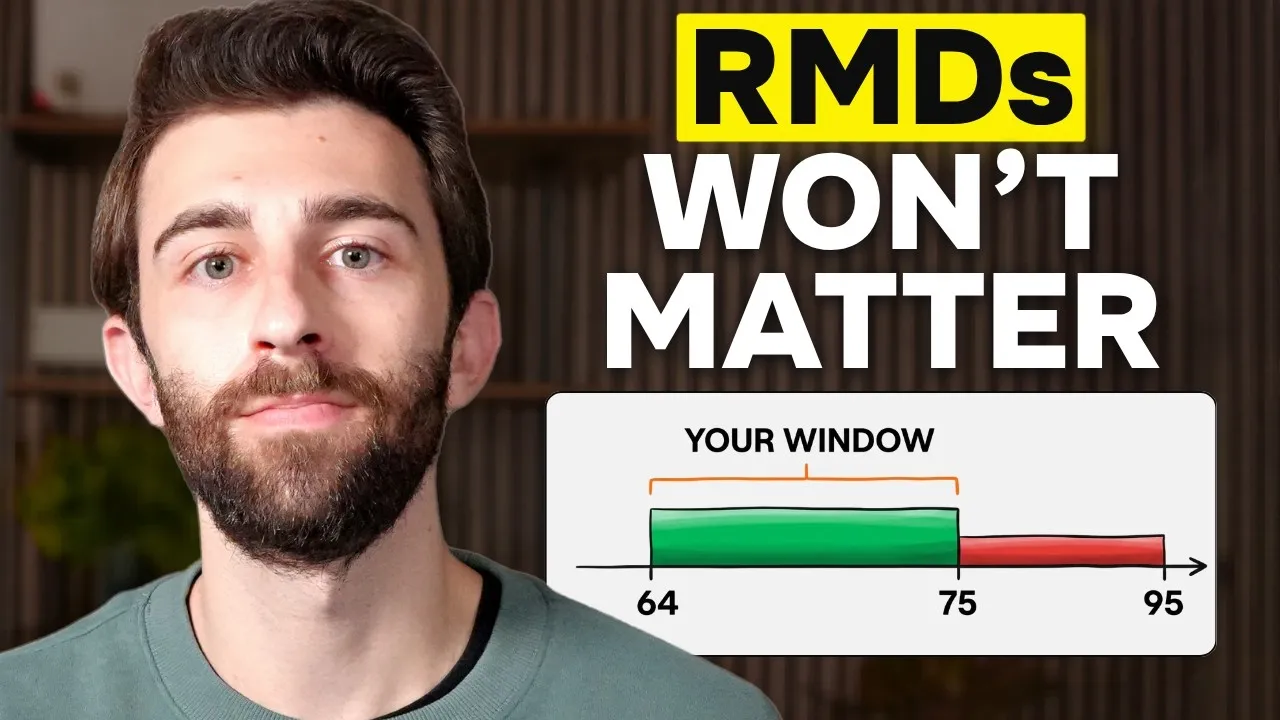
Withdrawals begin at 73 if you were born from 1951 to 1958, and at 75 if you were born in 1960 or later. Birth year 1959 sits in a paragraph of the regulation that is marked reserved, so it is genuinely unresolved rather than something you have missed.
The first one has a quirk worth knowing. You can delay your very first withdrawal until April 1 of the following year — a hard deadline, not a month. That sounds helpful and often isn’t, because it lands two years of withdrawals in the same tax year.
Why the RMD calculation gets bigger every year
It is your account balance on December 31 of the previous year, divided by a life-expectancy factor from an IRS table. That is the whole calculation. The factor gets smaller as you get older, so the fraction you have to withdraw gets larger every year.
Two consequences follow from that, and they are the ones that matter for planning. The table, the divisor and a worked example are in how is an RMD calculated.
- It grows with the account. A balance that keeps compounding produces a larger required withdrawal every year, whether or not you need the money.
- It grows with your age, independently of the balance, because the divisor shrinks.
- Each account is calculated separately, but IRAs can be aggregated and the total taken from any one of them. Workplace plans generally cannot.
- The balance that counts is last year’s year-end number, so a market drop this year does not lower this year’s requirement.
- Nothing about the calculation depends on what you need. It is arithmetic on a balance and an age, and it does not know whether you were planning to spend the money.
The real issue isn’t the withdrawal
For most people the RMD itself is manageable. It’s a bit like carrying a couch out through a narrow doorway. The couch isn’t the problem. It’s the doorframe, the lamp on the table, and the wall on the way out. What catches them is everything else it touches: the bracket it pushes them into, and the Medicare premium it sets two years later.
By the time RMDs start, most of the planning levers have already closed. That’s why this topic belongs to your fifties and sixties, not your seventies.
It helps to see what the requirement actually does to a year. It does not take money away from you. It moves money you already owned into a column that other things are priced off. It does that every year, in a rising amount. And it starts at an age when you have the fewest ways left to offset it.
The people who find this manageable are almost always the ones who saw it coming. Not because they did anything clever, but because they spent ten or fifteen years quietly making the account smaller before the requirement arrived.
If it helps to have the numbers in one place, I keep them all in the Ultimate Retirement Guide.
What is a qualified charitable distribution?
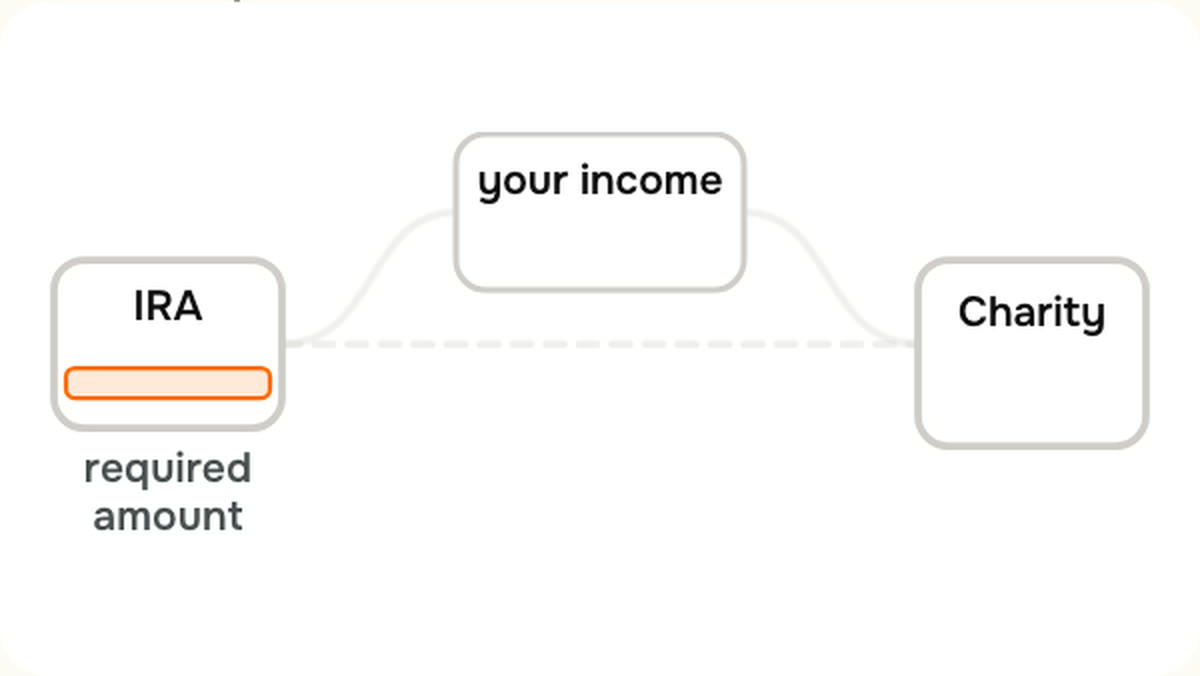
A qualified charitable distribution is money sent straight from your IRA to a charity, without passing through your hands. It counts toward your required withdrawal for the year, and it never lands in your income.
That combination is unusual in the tax code. Most charitable giving only helps if you itemize, so a retiree who takes the standard deduction gets no tax benefit from giving at all. A QCD works whether you itemize or not, because it works by keeping income off the return rather than by adding a deduction to it.
You are eligible at 70½, which is not the same as the age your required withdrawals begin. The gap is worth noticing. There are several years in which you can make a QCD before you have any required withdrawal to offset with it.
- It has to come from an IRA. A 401(k) or another workplace plan cannot make a qualified charitable distribution, even though it does have a required withdrawal of its own. Rolling that money into an IRA first is what makes it possible, and that is a decision with its own consequences.
- It has to go directly from the IRA to the charity. Take the money first and it stops being a QCD.
- The charity has to be an eligible one. Donor-advised funds and private foundations generally do not qualify.
- There is an annual cap per person, and the IRS adjusts it for inflation each year. Check the current figure before you plan around it.
- It comes off the top of your required withdrawal, so it reduces the taxable part rather than adding to it.
- Timing inside the year matters. The first dollars out of the IRA count toward the requirement, so a QCD done after you have already taken the full amount cannot offset it.
- Both spouses can do it, from their own IRAs, each up to the cap.
- Keep the paperwork. The 1099-R will not show that it was a QCD, so your return has to say so.
- It beats a deduction, and that is the real point. A deduction lowers your taxable income. A QCD stops the money from being income at all. Your Medicare surcharge and the tax on your Social Security are both priced off the number before deductions, so keeping income off the return moves things a deduction never touches.
A worked example: giving from the IRA instead of the checkbook
This is the clearest way to see why a QCD is different from writing a check for the same amount to the same charity.
Illustrative example
Margaret, 74, who gives to her church every year and takes the standard deduction
Her required withdrawal this year is $40,000. She plans to give $10,000, the same as she gives every year. Like most retirees, she does not itemize. That no longer means nothing: a non-itemizer can now deduct cash gifts up to $1,000, or $2,000 on a joint return. On a $10,000 gift, though, that is most of it going undeducted.
- Required withdrawal
- $40,000
- Gift to her church
- $10,000
- If she withdraws, then donates: income reported
- $40,000
- Deduction she gets for the gift
- $1,000 (the non-itemizer cap)
- If she gives $10,000 as a QCD: income reported
- $30,000
- Requirement still satisfied?
- Yes, in full
Same charity, same $10,000, same $40,000 out of the IRA. The only difference is which door the money leaves by.
One route reports $40,000 of income and the other reports $30,000. That $10,000 gap is not just a smaller tax bill this year. It is $10,000 that is not counted toward how much of your Social Security is taxed, which reaches an income like hers. It is also $10,000 off the number that sets your Medicare surcharge two years later — that one costs nothing until the number is near a tier line, and it is the same lever either way.
This is why the order of operations matters more than the amount. She was always going to give the money.
A hypothetical household with round numbers, built to show the arithmetic. Not a real person, and not a recommendation.
What people get wrong about RMDs and QCDs
Nearly every mistake here is a timing mistake rather than a math mistake, and most of them are only fixable before December 31.
- Taking the money first, then donating it. That is an ordinary withdrawal and an ordinary gift. The QCD has to go directly.
- Assuming the RMD age is one number. It is 73 for people born between 1951 and 1958, and 75 for people born in 1960 or later.
- Delaying the first withdrawal to April without doing the math. It can put two years of income into one tax year.
- Waiting for RMDs to start before thinking about them. By then most of the useful levers have closed.
- Assuming a Roth IRA has an RMD. It does not while you are the original owner.
- "I’ll do a QCD from my 401(k)." You can’t. It has to be an IRA.
- Forgetting that a QCD is available before required withdrawals begin. Eligibility starts at 70½ regardless of when your withdrawals do.
- Not telling the tax preparer. The 1099-R looks identical either way, so an unreported QCD gets taxed.
When this does NOT apply to you
Plenty of people never need to plan around this at all. Treating it as a problem when it isn’t one leads to worse decisions than ignoring it.
- If your tax-deferred balance is modest, the required withdrawal will be small and is unlikely to change your bracket or your Medicare premium.
- If you were going to spend the money anyway, the requirement is not costing you anything. It is only forcing the timing of something you planned to do.
- If you do not give to charity, QCDs are irrelevant. Do not start giving for the tax treatment. That is spending a dollar to save a fraction of one.
- If everything you hold is in Roth accounts or taxable accounts, there is no required withdrawal to plan around.
- If you are still working past the required age and have a workplace plan at that employer, that plan may be able to wait. Your IRAs still cannot.
How this connects to the other six
Required withdrawals are the deadline that gives every other decision on this site its urgency. They are the point at which your income stops being something you choose.
- Roth conversions are the main way to make a future required withdrawal smaller, and the years before it starts are when they are cheapest.
- Withdrawal strategy decides how big the tax-deferred balance is by the time the requirement arrives.
- Healthcare in retirement is where a large withdrawal shows up again two years later, as a Medicare surcharge.
- Social Security timing stacks on top of the requirement, and the two together are what set your bracket in your seventies.
- Estate and legacy is what is left in the account afterwards, and a traditional IRA is the least tax-friendly thing to leave behind.
Sources (7)
- SSA POMS HI 01101.020 — MAGI is taken from the tax return two years prior, or three years prior when the two-years-prior return is unavailable (opens in a new tab) · checked 2026-07-31
- Treas. Reg. §1.401(a)(9)-2(b)(2)(iv) — "In the case of an employee born on or after January 1, 1951, but before January 1, 1959, the applicable age is age 73" (opens in a new tab) · checked 2026-08-01
- Treas. Reg. §1.401(a)(9)-2(b)(2)(vi) — "In the case of an employee born on or after January 1, 1960, the applicable age is age 75" (opens in a new tab) · checked 2026-08-01
- Treas. Reg. §1.401(a)(9)-2(b)(2)(iv)–(vi) — the required withdrawal age is 73 for someone born from 1951 through 1958, and 75 for someone born in 1960 or later. The paragraph that would set it for birth year 1959, (v), is printed in the regulation as reserved and left blank, so that year is genuinely unresolved. (opens in a new tab) · checked 2026-08-01
- 26 U.S.C. §408(d)(8)(B)(ii) — a qualified charitable distribution is one "made on or after the date that the individual for whose benefit the plan is maintained has attained age 70½" (opens in a new tab) · checked 2026-08-06
- 26 U.S.C. §170(p) — "if the individual does not elect to itemize deductions for such taxable year, the deduction under this section shall be equal to the deduction, not in excess of $1,000 ($2,000 in the case of a joint return)", as amended by Pub. L. 119-21 §70424(a) (substituting "$1,000 ($2,000" for "$300 ($600"), effective for taxable years beginning after December 31, 2025 (§70424(b)) (opens in a new tab) · checked 2026-08-03
- 26 U.S.C. §170(p) — the non-itemizer deduction is "not in excess of $1,000 ($2,000 in the case of a joint return)", as amended by Pub. L. 119-21 §70424(a), effective for taxable years beginning after December 31, 2025 (§70424(b)) (opens in a new tab) · checked 2026-08-03