What Is the Roth Conversion 5-Year Rule?
There are two five-year clocks, not one. Which decides whether earnings come out tax free, which decides the 10% additional tax, and when each starts.
There are two five-year rules, not one. The first decides whether your Roth earnings come out tax free. The second decides whether a converted amount escapes the 10% additional tax on early distributions. They start on different dates and stop mattering at different times.
Almost every article on this subject treats them as one rule. That is where the confusion comes from, and it is why people either wait five years they did not need to wait, or take money out a year too early and get a bill they did not expect.
Think of it as two stopwatches running on the same account. One was started the first time you ever put a dollar into any Roth IRA. The other gets started fresh every time you convert. Reading the wrong stopwatch is the whole problem.
Why are there two five-year clocks and not one?
Because they answer two different questions.
The qualified-distribution clock decides whether a distribution is qualified — meaning the earnings come out completely tax free. Under IRS Publication 590-B, a distribution is qualified if it is made after the five-year period beginning with the first tax year for which a contribution was made to a Roth IRA set up for your benefit. It must also be made on or after you reach age 59½ — or on account of death, disability, or a first home, subject to a $10,000 lifetime cap on the first-home exception. Both halves have to be true.
The statute underneath that is 26 U.S.C. §408A(d)(2), and it is split in a way worth seeing. Subparagraph (A) is the list of triggers — reaching age 59½, death, disability, or a qualified special purpose distribution, which is the first-home case. Subparagraph (B) is the clock. It says a distribution “shall not be treated as a qualified distribution under subparagraph (A) if such payment or distribution is made within the 5-taxable year period beginning with the first taxable year for which the individual made a contribution to a Roth IRA… established for such individual.”
Read that phrasing closely. One period. Counted from the first taxable year you contributed. To a Roth IRA, not to this Roth IRA. That is why there is a single account clock per person no matter how many Roth accounts you go on to open, and why a trigger on its own is not enough — subparagraph (B) can disqualify a distribution that satisfies every item in subparagraph (A).
The conversion clock decides whether the 10% additional tax on early distributions (26 U.S.C. §72(t)(1)) applies to money you converted. Publication 590-B is explicit that this one “is separately determined for each conversion and rollover, and isn’t necessarily the same as the 5-year period used for determining whether a distribution is a qualified distribution.”
So if you convert three years in a row, you have three separate conversion clocks — plus the single account clock underneath all of them.
Which clock applies to me at 62?
If you are 62 and you have never had a Roth IRA before, the account clock is running and the conversion clock is running too — it just cannot cost you anything, because you are already past the age where the 10% additional tax applies.
The conversion clock exists only to stop people from using a conversion as a way around the early-distribution tax. Publication 590-B lists reaching age 59½ as a situation in which you do not have to pay the 10% additional tax. Once you are past 59½, that tax is off the table on the converted principal regardless of how recently you converted.
What is still on the table is the account clock. Until it runs out, a withdrawal of earnings is not a qualified distribution, and the earnings portion is ordinary income to you. Not the converted amount — you already paid tax on that. The growth on top of it.
That is the practical answer for most people reading this: at 62, converting for the first time, the money you converted is available immediately without a penalty. The growth is not tax free yet.
What actually happens at 59½?
One clock effectively stops mattering and the other does not.
At 59½ the 10% additional tax on early distributions stops applying, which retires the per-conversion clock as a practical concern. Publication 590-B’s exceptions list includes reaching age 59½ directly.
The account clock keeps running. Age has no effect on it. A 72-year-old who opens their first Roth IRA this year is in exactly the same position on that clock as a 40-year-old who opens their first one this year. Both halves of the qualified-distribution test have to be satisfied, and being well past 59½ satisfies only one of them.
When does the clock start? Does a December conversion count for the whole year?
Yes, and this is the one piece of timing worth knowing.
The regulation is specific. Under 26 CFR 1.408A-6, A-2, the five-taxable-year period “begins on the first day of the individual’s taxable year for which the first regular contribution is made to any Roth IRA of the individual or, if earlier, the first day of the individual’s taxable year in which the first conversion contribution is made.” It ends “on the last day of the individual’s fifth consecutive taxable year.”
The conversion clock works the same way. Publication 590-B describes it as starting with “the first day of your tax year in which you convert.”
Here is an illustrative example, and the arithmetic matters more than the dates. Say a calendar-year taxpayer converts on December 15 of year one. The clock does not start on December 15. It starts on January 1 of year one, and it runs through the last day of the fifth consecutive taxable year — years one, two, three, four, five. The money is clear on January 1 of year six.
Now say the same person waits and converts on January 2 of year two instead. That clock runs years two through six, and clears on January 1 of year seven. Two conversions a little over two weeks apart, and one of them is clear a full year sooner.
It is a calendar-year rule, not a day-count rule. Nothing is prorated.
There is one more wrinkle in the same regulation: if the first dollar you ever put into a Roth IRA was a regular contribution — not a conversion — the clock can reach back further than the year you made it. Under A-2, a contribution made between January 1 and the following April 15 can be designated for the prior tax year, and if it is, the five-year period begins on January 1 of that prior year. Someone who opens a first Roth IRA in the spring with a contribution designated for the previous year picks up a free year on the clock they would not get by converting.
Illustratively, because the mechanic is easier to see than to describe: a contribution made in April of this year and designated for last year starts the account clock on January 1 of last year, not on the day it was deposited. Same money, same deposit, a full year earlier on the clock. If you are opening a first Roth IRA in the spring, which tax year the contribution is designated for is worth settling before the money moves.
If it helps to have the numbers in one place, I keep them all in the Ultimate Retirement Guide.
If I take money out of a Roth, which dollars come out first?
There is a fixed order, and you do not get to choose it. From 26 CFR 1.408A-6, A-8, a distribution from a Roth IRA comes out in this sequence, exhausting each category before moving to the next:
- Regular contributions — the annual contributions you made out of pocket.
- Conversion contributions, on a first-in-first-out basis — earliest conversion year first. Within a single conversion, the portion that was taxable when you converted comes out before the portion that was not.
- Earnings.
Earnings are last. That is the part people miss, and it is favorable to you: the money that carries the tax exposure is at the bottom of the stack, not the top.
Your regular contributions come out tax free and penalty free at any time, and neither clock has anything to say about it. You already paid tax on those dollars before they went in. There is nothing left to tax and nothing to wait for. Neither five-year period gates your basis. What the account clock actually gates is the earnings, and the ordering rules put the earnings at the very bottom.
This is also where the two clocks stop being an abstract distinction. A withdrawal reaches your contributions first, then your oldest conversions, then the growth — so the two rules can apply to the same withdrawal at different depths. A conversion can be completely clear of its own five-year period, or you can be past 59½ where the 10% additional tax under 26 U.S.C. §72(t)(1) is off the table regardless, and the earnings sitting underneath that conversion can still be short of the account clock. Clearing one clock tells you nothing about the other. The question is always which layer you are actually reaching.
The rule also aggregates. All distributions from all of your Roth IRAs during a taxable year are added together for this purpose, and so are all conversions received in the same year. You cannot isolate one account and call the withdrawal something else by taking it from there.
Does a conversion I did years ago at a different custodian still carry its clock?
Yes. The clock belongs to you, not to the account or the firm holding it.
The regulation says the account clock begins with the first contribution “to any Roth IRA of the individual,” and states plainly that “each Roth IRA owner has only one 5-taxable-year period… for all the Roth IRAs of which he or she is the owner.” Publication 590-B’s aggregation rules add together all of your Roth IRAs the same way.
Moving a Roth from one custodian to another does not restart anything. Opening a second Roth IRA does not start a second account clock. What the move can do is destroy your records — and the ordering rules run on exactly that information: what was a contribution, what was a conversion, and in which year. The rule survives a custodian change. The documentation of it may not.
What happens to the clocks when I die?
The account clock does not restart for your heir. That question is answered directly in 26 CFR 1.408A-6, A-7: the beginning of the five-taxable-year period “is not redetermined when the Roth IRA owner dies,” and the period the account is held in the name of a beneficiary “includes the period it was held by the decedent.”
So if you had satisfied the clock before death, your heir inherits an account that is already past it. If you had not, they finish out the remaining years.
For a non-spouse beneficiary, that inherited clock is the only one that counts. The regulation is explicit that it is “determined independently” of the five-year period on any Roth IRA the beneficiary already owns in their own name. A beneficiary who has had their own Roth open for twenty years does not get to borrow that clock for the account they just inherited.
Two things to note alongside that. A distribution to a beneficiary after the owner’s death meets the second half of the qualified-distribution test on its own — death is one of the listed triggers — so the account clock is the only piece left. And Publication 590-B lists being the beneficiary of a deceased IRA owner among the situations where the 10% additional tax does not apply.
A surviving spouse is a special case. If a spouse treats the inherited Roth as their own, the regulation says their five-year period ends at the earlier of the decedent’s period or their own. That one runs in the heir’s favor.
Separately, an inherited Roth generally still has to be emptied by December 31 of the calendar year containing the tenth anniversary of the death, under the 10-year rule (Treas. Reg. §1.401(a)(9)-5(e)(2)), even though it remains tax free. Tax-free is not the same as untouched.
What do people get wrong about this?
They think converting resets their tax-free status. It does not. If your first Roth IRA was funded years ago, that clock has been running the whole time and a conversion today does not disturb it.
They think the 10% applies to converted money after 59½. It does not. That is what the exception at 59½ is for.
They count from the conversion date. The rule counts taxable years, from January 1 of the year of the conversion.
They think each new Roth account starts a new account clock. There is one account clock per person.
They assume the earnings come out first. The ordering rules put earnings last, which usually works out better than people expect.
They treat “no 10% tax” and “tax free” as the same statement. They are two different tests with two different clocks. A distribution can clear one and fail the other.
When this does not apply to you
This page is about a specific mechanical rule, and there are people it simply does not reach.
- You have no Roth IRA and no plan to open one. Nothing here has a clock to run.
- You are past 59½ and your first Roth IRA was funded more than five taxable years ago. Both clocks are behind you. New conversions do not start anything that affects you.
- You have no intention of touching the Roth in your lifetime. If the account is earmarked for heirs, the clock will almost certainly be satisfied long before anyone takes a distribution, and the ordering rules never come up.
- Your Roth money is inside a Roth 401(k) you have not rolled over. Designated Roth accounts in an employer plan have their own five-year rule, and it is not the one described here.
- The reason you are asking is a backdoor Roth contribution. That involves a conversion step and the same clocks, but the pro-rata rules on your traditional IRA balances usually matter more than the clocks do. That is a different subject, and I have written it up alongside the plan version in the mega backdoor Roth.
For most people who are already retired, already past 59½, and already have a Roth open, the honest answer is that the five-year rule is a smaller obstacle than the internet makes it sound. Where it genuinely bites is the person opening their first Roth IRA at 62 and expecting to spend the growth within a few years.
If you want the full picture of how conversions fit with brackets, Medicare surcharges, and the years before you claim Social Security, that is the Roth conversions topic hub.
Illustrative example
Errol and Trudy, both 63, taking money out of a Roth they opened recently
Errol converted in each of the two most recent years and has never made a regular Roth contribution, so the account holds converted dollars and their growth and nothing else. Every figure is round and invented, chosen to show which layer a withdrawal reaches.
They are both past the age at which the additional tax on early distributions stops applying, so the per-conversion clocks cannot cost them anything. The account clock is the one still running.
They need money for a roof. The question is not whether they are allowed to take it — they are — but what it is when it arrives.
- Earliest conversion, made first
- $70,000
- Later conversion, made the following year
- $50,000
- Earnings sitting on top of both
- $9,000
- Account value before the withdrawal
- $129,000
- Taken out for the roof
- $40,000
- Which layer that reaches
- The earliest conversion, first in and first out
- Reported as income on that withdrawal
- $0
- Account value after the withdrawal
- $89,000
The withdrawal never got near the earnings. The ordering rules exhaust conversions before touching growth, and their oldest conversion alone is larger than what they took.
Two separate things had to be true for that answer, and only one of them is about the clocks. The converted dollars were already taxed, so there is nothing left to tax on them. And they are past the age where the additional tax applies, so the per-conversion clock has nothing to reach.
The account clock is still unfinished, and on these figures it did not matter. It gates the earnings, and the earnings are at the bottom of the stack. A withdrawal large enough to reach through both conversions would be a different conversation, on the same account, in the same year.
Clearing one clock tells you nothing about the other. The question is always which layer the withdrawal actually reaches, and that depends on their own records of what was contributed, what was converted, and in which year.
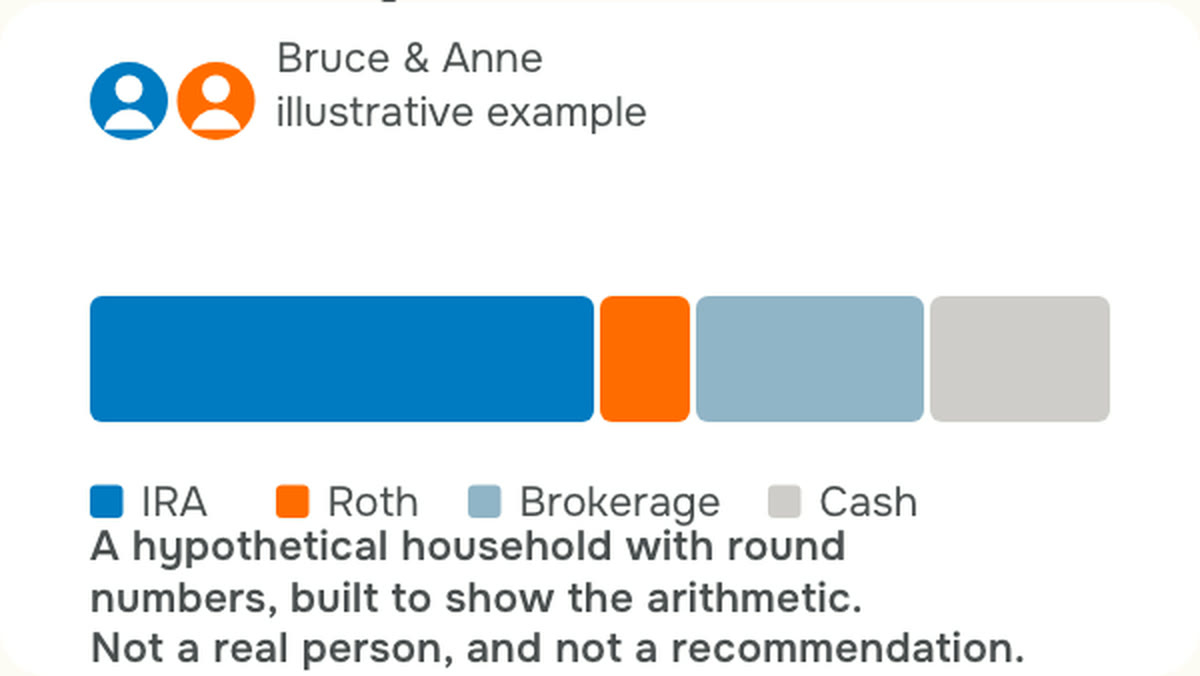
A hypothetical household with round numbers, built to show the arithmetic. Not a real person, and not a recommendation.
Sources (3)
- 26 U.S.C. §72(t)(1) — "the taxpayer's tax under this chapter for the taxable year in which such amount is received shall be increased by an amount equal to 10 percent of the portion of such amount which is includible in gross income" (opens in a new tab) · checked 2026-08-03
- Treas. Reg. §1.401(a)(9)-5(e)(2) — for a designated beneficiary who is not an eligible designated beneficiary, the year by which the entire interest must be distributed is "the calendar year that includes the tenth anniversary of the date of the employee's death" (opens in a new tab) · checked 2026-08-02
- 26 CFR §1.408A-6, A-2 — the 5-taxable-year period "begins on the first day of the individual's taxable year for which the first regular contribution is made … ends on the last day of the individual's fifth consecutive taxable year", and "each Roth IRA owner has only one 5-taxable-year period … for all the Roth IRAs of which he or she is the owner" (opens in a new tab) · checked 2026-08-03
Example case study. Details are changed and some examples combine more than one household. Nothing here is a recommendation, and your own numbers will be different.
