Should a 65-Year-Old Retiree Do Roth Conversions?
Short answer. A retiree at Medicare age can convert; there is no age limit. Whether to depends on today’s bracket against RMD-year brackets, premiums and heirs.
A 65-year-old retiree can do a Roth conversion, and whether they should depends on three comparisons: the tax bracket a conversion lands in today against the bracket that money would be taxed in once required withdrawals begin, the Medicare premium the extra income will set 2 years from now, and whether the people who inherit the account would pay more or less tax than the owner. There is no age limit and no income limit on converting, under 26 U.S.C. §408A(d)(3). The question at 65 is not whether a conversion is allowed but what it costs and what it buys.
This page is educational. It describes what a retiree at this age weighs; it cannot tell any particular household what to do.
What makes 65 a common age to consider a Roth conversion?
Age 65 is a common age to consider a Roth conversion because for many retirees it sits inside the window between the last paycheck and the first required withdrawal, when taxable income is lower than it was while working and lower than it will be later.
Required minimum distributions begin at 73 or 75 depending on birth year, under Treas. Reg. §1.401(a)(9)-2(b)(2). Until then, a retiree chooses how much income to recognize. A conversion in a low-income year moves money out of a pre-tax account at today’s rate rather than at the rate it would face when required withdrawals and Social Security stack together. When RMDs start explains which age applies.
The window is also finite. Each year that passes without converting is a year of the gap gone, which is why the question tends to arrive around this age rather than later.
What does a Roth conversion at 65 cost that it did not cost earlier?
A Roth conversion at 65 costs something it did not cost at 60: it can raise the Medicare premium. Medicare eligibility begins at 65 under 42 U.S.C. §426(a), and from then on Part B and Part D premiums carry an income-related surcharge for higher incomes. Under 20 C.F.R. §418.1135, Social Security sets that surcharge from the tax return 2 years before the premium year.
A conversion this year therefore shows up as a premium increase 2 years later, and the surcharge moves in whole tiers. A conversion that crosses a threshold by a small amount costs the full tier. How IRMAA is calculated explains the mechanics, and the IRMAA two-year lookback explains the delay.
If the retiree is already drawing Social Security, a conversion also raises provisional income, which can pull more of the benefit into taxable income in the same year under 26 U.S.C. §86. Both effects argue for sizing a conversion to a threshold rather than converting a round number.
If it helps to have the numbers in one place, I keep them all in the Ultimate Retirement Guide.
What does a Roth conversion at 65 buy?
A Roth conversion at 65 buys a smaller pre-tax balance when required withdrawals begin, growth that is never taxed again, and an account the original owner never has to draw from.
Every converted dollar is a dollar no longer in the traditional IRA, so each later required distribution is calculated on a smaller balance, which the RMD calculator makes visible. A Roth IRA has no required distributions for its owner under 26 U.S.C. §408A(c)(5), so what is converted can stay invested as long as the owner lives. And the people who inherit a Roth still have to empty it, but the withdrawals come to them tax free.
That last point is often the deciding one. If the heirs are likely to be in a higher bracket than the owner, paying tax now at the owner’s rate can leave them more. If the heirs are in a lower bracket, or the account is headed to charity, the arithmetic often runs the other way.
Does the five-year rule matter for a Roth conversion at 65?
The five-year rule matters less for a Roth conversion at 65 than for a younger converter, because the per-conversion clock only guards the additional tax on early distributions, which stops applying after age 59½ under 26 U.S.C. §72(t)(2)(A)(i). The converted amount is available without that penalty.
The account’s own five-year clock still applies to earnings. If this is the retiree’s first Roth, growth comes out tax free only after five tax years from the first contribution or conversion, under 26 U.S.C. §408A(d)(2)(B). The Roth conversion five-year rule covers both clocks.
How does a 65-year-old retiree decide?
A 65-year-old retiree decides by running the comparison on their own numbers: the marginal rate a conversion would pay this year, including state tax and any premium tier it crosses, against the rate the same dollars would pay in the years of required withdrawals, with the heirs’ likely bracket as the tiebreaker. Is it too late for a Roth conversion at 65 or after 73 covers what changes once required withdrawals have already begun.
A conversion is a bet that today’s rate is lower than tomorrow’s. For some households at this age that bet is clearly good, for some it is clearly not, and for many it is a question of size rather than yes or no. None of that can be read off an age.
Frequently asked questions
Is there an age limit on Roth conversions for a retiree around Medicare age?
No, a retiree at this age can do a Roth conversion. Whether to depends on three comparisons: the bracket a conversion lands in today against the bracket the money would face once required withdrawals begin, the Medicare premium the extra income sets two years later, and whether the people who inherit are likely to be in a higher or lower bracket.
Why do people consider Roth conversions between retiring and starting RMDs?
For many retirees that window has lower taxable income than during working years or later. Until required withdrawals begin, a retiree chooses how much income to recognize. A conversion then moves money out of a pre-tax account at today’s rate rather than the rate it may face later.
How can a Roth conversion affect my Medicare premiums?
A conversion raises your income, and Medicare Part B and Part D premiums carry an income-related surcharge. Social Security sets that surcharge from your tax return two years earlier, and it moves in whole tiers. Crossing a threshold by a small amount costs the full tier.
What does a Roth conversion buy a retiree?
A Roth conversion leaves a smaller pre-tax balance when required withdrawals begin, so each later required distribution is calculated on less. The converted money grows without being taxed again. A Roth IRA also has no required distributions for its owner.
Should a retiree do Roth conversions?
Whether a retiree should convert depends on the household’s own numbers, and an age alone cannot answer it. The comparison is the marginal rate a conversion would pay this year, including state tax and any premium tier it crosses, against the rate the same dollars would pay later. For many households it is a question of size rather than yes or no. This is educational, not personalized advice.
Illustrative example
Two invented retirees at the same age with the same IRA
Both have just reached Medicare age and hold the same pre-tax balance. Every figure below is invented and round, chosen only to show what makes the same conversion look different for two households. Nothing here is a recommendation or a forecast.
- Pre-tax IRA, both
- $1,200,000
- Retiree A: other income this year
- $40,000
- Retiree A: expected income once required withdrawals begin
- $130,000
- Retiree B: other income this year
- $150,000
- Retiree B: expected income once required withdrawals begin
- $160,000
- Room between today’s income and the later income
- A: large. B: small.
Retiree A has a gap to fill. Income today sits far below where it will be once required withdrawals start, so converting some of the IRA now moves money from a later, higher bracket into a lower one today.
Retiree B has almost no gap. Income today is already near the later level, so a conversion adds tax now at roughly the same rate it would have been paid later, and may lift a Medicare premium for little gain.
Neither line decides anything on its own. Brackets, premium tiers, state tax, heirs’ brackets and how long the money stays invested would all move it, and each household has to run its own numbers.
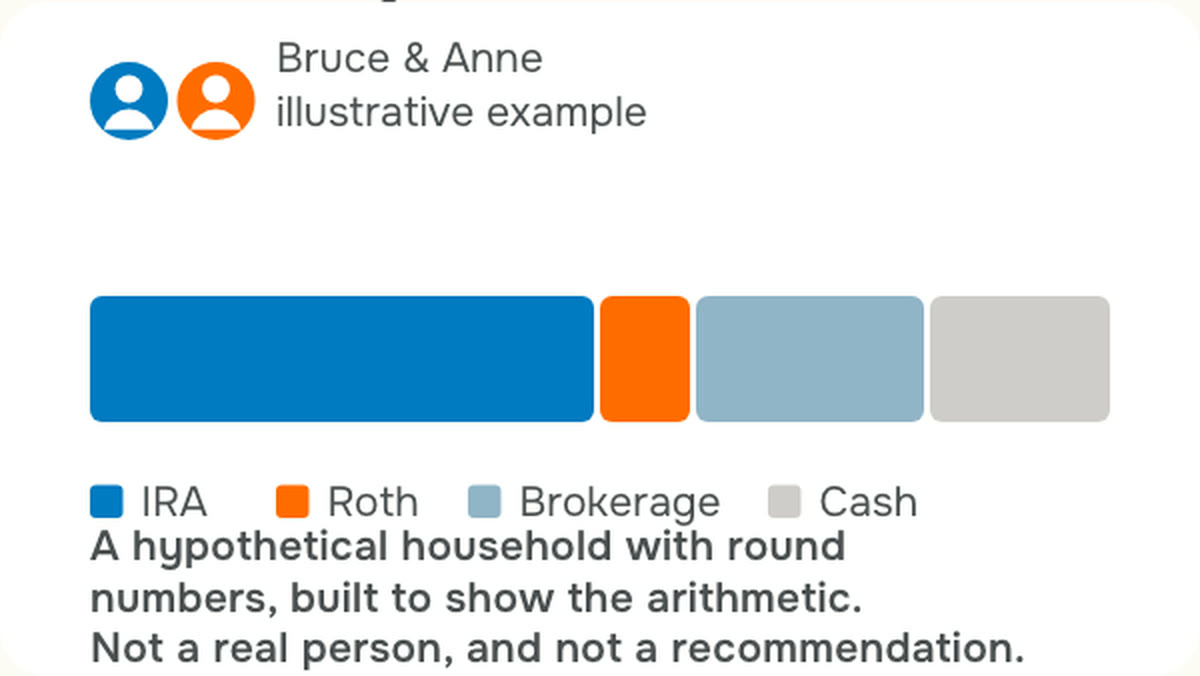
A hypothetical household with round numbers, built to show the arithmetic. Not a real person, and not a recommendation.
Sources (4)
- 42 U.S.C. §426(a) — "Every individual who— (1) has attained age 65" is entitled to hospital insurance benefits on meeting the remaining conditions of that subsection. (opens in a new tab) · checked 2026-08-06
- SSA POMS HI 01101.020 — MAGI is taken from the tax return two years prior, or three years prior when the two-years-prior return is unavailable (opens in a new tab) · checked 2026-07-31
- Treas. Reg. §1.401(a)(9)-2(b)(2)(iv) — "In the case of an employee born on or after January 1, 1951, but before January 1, 1959, the applicable age is age 73" (opens in a new tab) · checked 2026-08-01
- Treas. Reg. §1.401(a)(9)-2(b)(2)(vi) — "In the case of an employee born on or after January 1, 1960, the applicable age is age 75" (opens in a new tab) · checked 2026-08-01
Example case study. Details are changed and some examples combine more than one household. Nothing here is a recommendation, and your own numbers will be different.
