Is It Too Late for a Roth Conversion at 65 or After 73?
Short answer. A Roth conversion has no age or income limit, so 65 or 75 is not too late. Once RMDs begin, the required amount comes out first and cannot be converted.
People ask me this as if a door closes at some birthday. It does not. A Roth conversion has no age limit, and it has had no income limit for years. What changes as you get older is everything around the conversion: what the extra income touches, and, once required distributions start, the order the money has to come out in.
Is there an age limit on a Roth conversion?
A Roth conversion has no age limit. You can convert a traditional IRA to a Roth IRA at 65, at 73, at 85, or in any year you hold one. The statute, 26 U.S.C. §408A(d)(3), treats a conversion as a taxable distribution followed by a rollover, and nothing in it ties that to age.
There is no income limit either. Contributions to a Roth IRA are limited by income. Conversions are not, and have not been since the income ceiling on conversions was repealed.
So the honest answer to “is it too late” is no. The useful question is what a conversion costs at your age, and that has changed.
What changes about a Roth conversion after 65?
After 65, a Roth conversion starts reaching two things it did not reach before: the taxation of your Social Security benefit, and your Medicare premium.
Social Security. Under 26 U.S.C. §86, how much of your benefit is taxable depends on what the code calls provisional income: your adjusted gross income, plus tax-exempt interest, plus half of your benefit. A conversion is ordinary income, so it raises provisional income dollar for dollar. Once you are claiming, a conversion can make more of your benefit taxable in the same year. The mechanics are in how much of Social Security is taxable.
Medicare. You become eligible for Medicare at 65 under 42 U.S.C. §426(a). From then on, your Part B and Part D premiums can carry a surcharge called IRMAA, and Social Security sets it from your tax return two years earlier, per 20 C.F.R. §418.1135. A conversion this year shows up as a higher premium two years from now. That delay is why people are surprised by it. The details are in the IRMAA two-year lookback.
Neither of these makes a conversion a bad idea. They make the size of the conversion matter more. A conversion sized to stay below the next premium tier can cost far less than one that crosses it by a few dollars.
Full answer: Should a 65-year-old retiree do Roth conversions?.
What changes about a Roth conversion after 73?
After required distributions begin, a Roth conversion still works, but the required distribution must come out first and cannot itself be converted.
Required distributions start at 73 or 75, depending on the year you were born, under Treas. Reg. §1.401(a)(9)-2(b)(2). When RMDs start walks through which age applies to you.
Two rules matter in those years. IRS Publication 590-A says you cannot convert an amount that must be distributed from your traditional IRA for that year. And the first dollars that leave the account in a year a distribution is required count toward the requirement. Put together: in an RMD year, you take the required amount first, pay tax on it as ordinary income, and only then can you convert anything on top. The RMD calculator shows what that required amount is for the year.
That stacking is the real cost of converting late. The required amount is already in your income before the conversion starts, so each converted dollar lands higher in your brackets than it would have before your required beginning date. That is why the years between retiring and your first RMD are often called the conversion window. Converting after it closes is still allowed. It is usually more expensive per dollar.
There is a second effect, and it can point the other way. Every dollar you convert is a dollar no longer in the traditional IRA, so future required distributions are calculated on a smaller balance. A conversion late in life can still shrink the required amounts that follow.
If it helps to have the numbers in one place, I keep them all in the Ultimate Retirement Guide.
Does the five-year rule still apply to a Roth conversion after 65?
The five-year rules still apply to a Roth conversion after 65, but only one of them can cost you anything.
Each conversion starts its own five-year clock for the additional tax on early distributions. That tax stops applying at 59½ under 26 U.S.C. §72(t)(2)(A)(i), so past that age the per-conversion clock has nothing to reach. The converted amount itself is available without that penalty.
The other clock is the account’s. Earnings in a Roth IRA come out tax free only after five tax years from your first Roth contribution or conversion, under 26 U.S.C. §408A(d)(2)(B). If this is your first Roth, that clock starts now, and growth taken out before it ends is taxable. The Roth conversion five-year rule explains both clocks in full.
Who benefits from a Roth conversion late in life?
A Roth conversion late in life most often benefits the people who will inherit the account, and that is worth naming plainly.
A Roth IRA has no required distributions for the original owner, under 26 U.S.C. §408A(c)(5). Your heirs still have to empty an inherited Roth on the same schedule as an inherited traditional IRA, but the money comes out to them tax free. If your heirs are likely to be in a higher bracket than you are, paying the tax now at your rate can leave more for them. If they are likely to be in a lower bracket, or the money is going to charity, the math often runs the other way.
That comparison depends on your bracket, your premiums, your heirs’ brackets and how long the money is likely to stay invested. It is a calculation on your own numbers, not a rule of thumb.
Frequently asked questions
Is there an age limit on a Roth conversion?
No. A Roth conversion has no age limit, and it has no income limit either. You can convert a traditional IRA in any year you hold one. What changes with age is what the extra income touches.
How does a Roth conversion affect Medicare premiums and Social Security taxes?
A conversion is ordinary income, so it raises the income used to decide how much of your Social Security benefit is taxable. It can also raise your Medicare Part B and Part D premiums through a surcharge called IRMAA. Social Security sets that surcharge from your tax return two years earlier, so a conversion this year shows up two years later.
Can I convert my required minimum distribution to a Roth IRA?
No. In a year when a distribution is required, the required amount has to come out first and cannot itself be converted. You pay ordinary income tax on it, and only then can you convert additional money on top. That stacking is the real cost of converting late.
Does the Roth five-year rule still apply if I convert after 65?
Only one of the two clocks can still cost you anything. The per-conversion clock for the 10% additional tax stops mattering once you are past 59½. The account clock still applies, so growth taken out before five tax years from your first Roth contribution or conversion is taxable.
Who benefits most from a late-in-life Roth conversion?
Often the heirs. A Roth IRA has no required distributions for the original owner, and heirs generally receive the money tax free. Whether paying the tax now makes sense depends on your bracket, your premiums and your heirs’ brackets, so it is a calculation on your own numbers.
Illustrative example
Ruth, converting in the years after her required distributions begin
Ruth is past her applicable age, so a required distribution is due from her IRA every year. She wants to move some of what remains into a Roth. Every amount below is invented and round.
- Her required distribution for the year
- $40,000
- What she wants to convert
- $30,000
- Which comes out of the IRA first
- The required distribution
- Can the required distribution be the money she converts?
- No
- Added to her taxable income for the year
- $70,000
The conversion still works. It simply sits on top of the required distribution rather than replacing it. Both amounts land in the same year’s income.
That stacked income is what Social Security taxation and the Medicare surcharge are measured against, so the real question for her is the size of the conversion, not whether she is allowed to make one.
Whether a conversion makes sense for a given household depends on its own brackets, its own premiums and its own heirs.
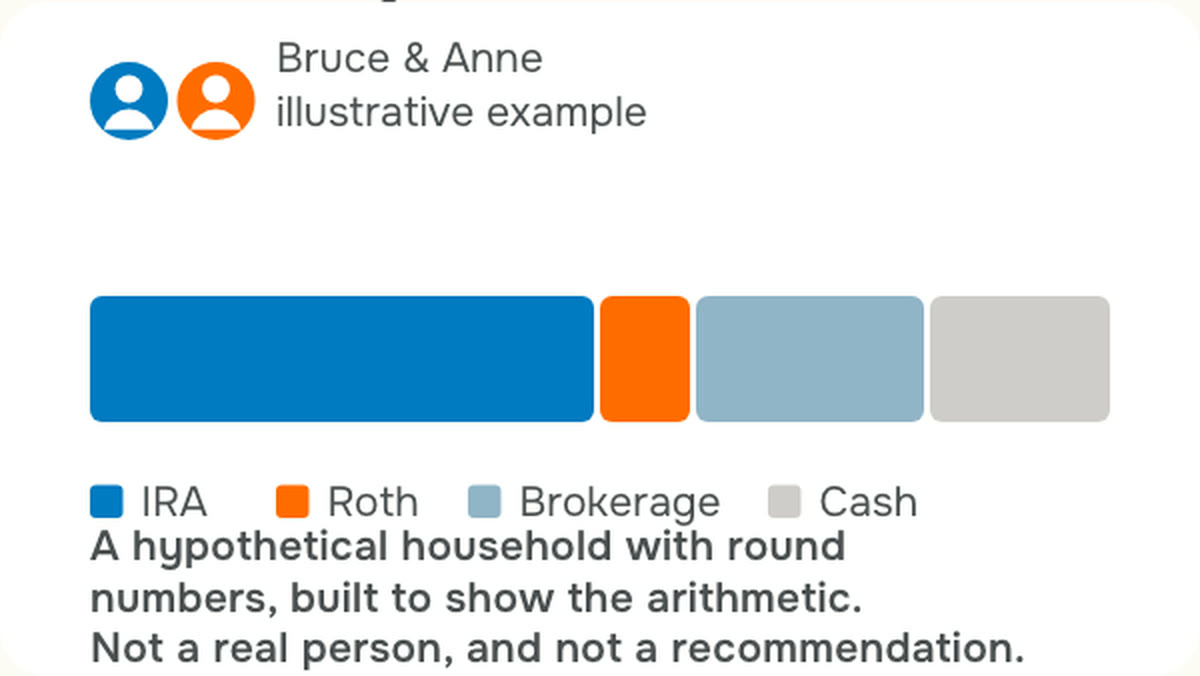
A hypothetical household with round numbers, built to show the arithmetic. Not a real person, and not a recommendation.
Sources (5)
- 42 U.S.C. §426(a) — "Every individual who— (1) has attained age 65" is entitled to hospital insurance benefits on meeting the remaining conditions of that subsection. (opens in a new tab) · checked 2026-08-06
- Treas. Reg. §1.401(a)(9)-2(b)(2)(iv) — "In the case of an employee born on or after January 1, 1951, but before January 1, 1959, the applicable age is age 73" (opens in a new tab) · checked 2026-08-01
- Treas. Reg. §1.401(a)(9)-2(b)(2)(vi) — "In the case of an employee born on or after January 1, 1960, the applicable age is age 75" (opens in a new tab) · checked 2026-08-01
- SSA POMS HI 01101.020 — MAGI is taken from the tax return two years prior, or three years prior when the two-years-prior return is unavailable (opens in a new tab) · checked 2026-07-31
- 26 U.S.C. §72(t)(2)(A)(i) — the 10-percent additional tax does not apply to distributions "made on or after the date on which the employee attains age 59½" (opens in a new tab) · checked 2026-08-06
Example case study. Details are changed and some examples combine more than one household. Nothing here is a recommendation, and your own numbers will be different.
